

Why Leonardo da Vinci used mirror writing: from the practical advantages of being left-handed to theories of secrecy, creativity and unconventional thinking.
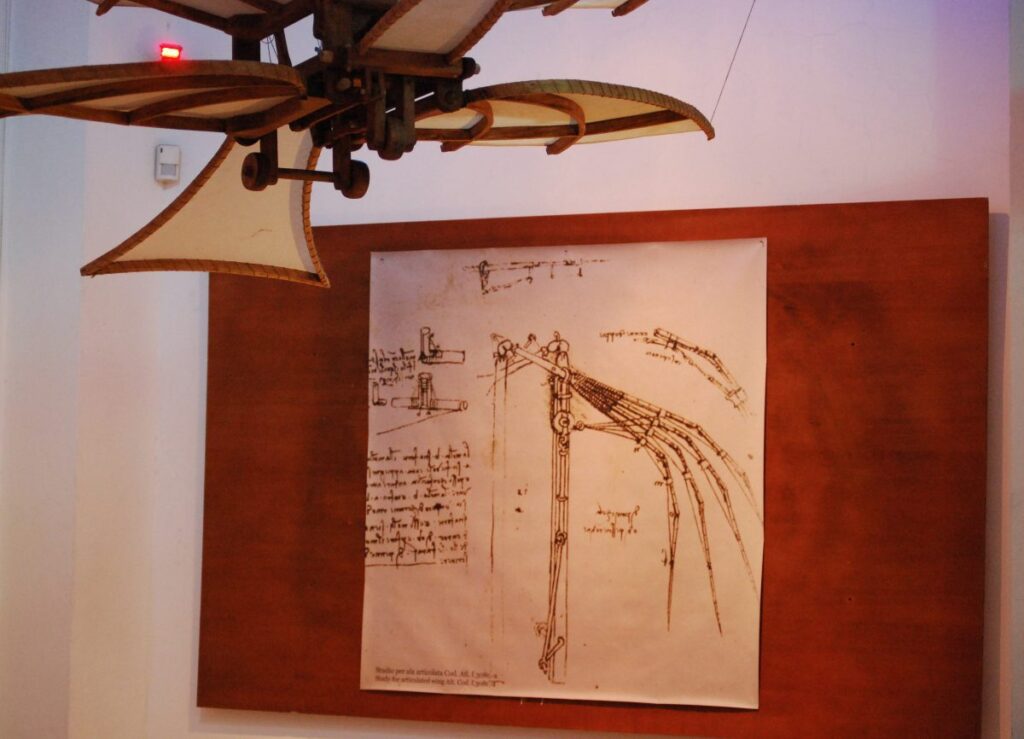
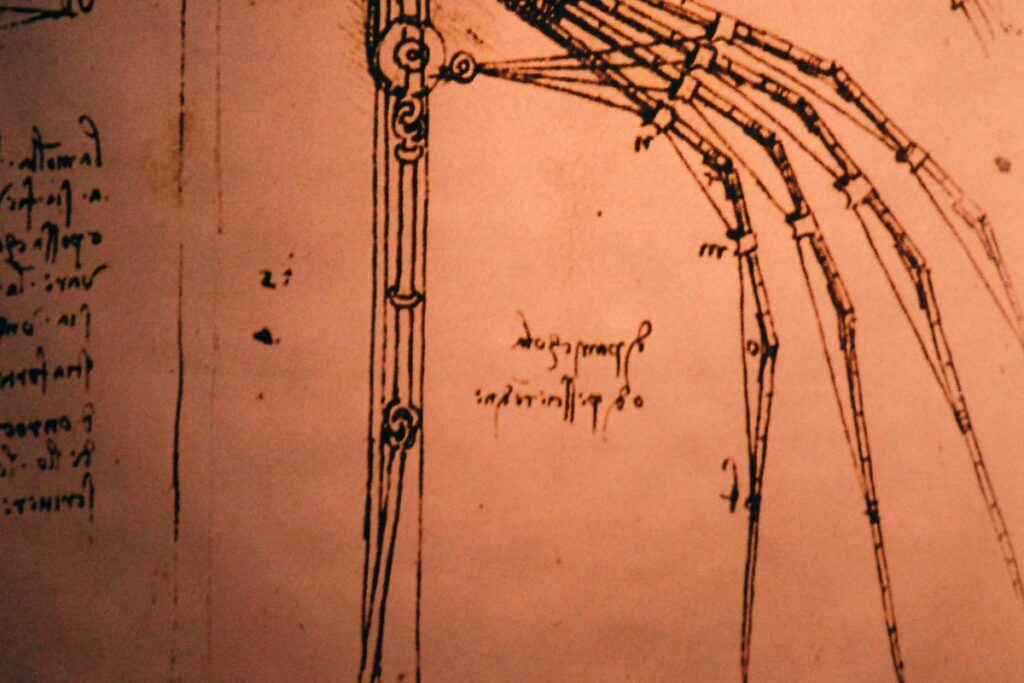
Leonardo da Vinci regularly wrote from right to left using mirror writing, a technique that has fascinated historians and visitors for centuries. The most widely accepted explanation is that, as a left-handed writer, writing backwards prevented him from smudging the ink, allowing him to write more quickly and neatly. Other theories suggest that Leonardo deliberately used mirror writing to protect his ideas at a time when plagiarism was common, making his notes more difficult to read without the key to deciphering them. Another possibility is that mirror writing was a genuine intellectual or artistic exercise, a creative challenge that reflected his constant desire to experiment with unconventional ways of thinking and working.
TABLE OF CONTENTS
- Writing backwards to avoid smudging the ink
- Did Leonardo write backwards to protect his notes?
- A natural habit or a deliberate technique?
- Mirror writing as a mental exercise
- A gesture of freedom and independence
- Mirror writing and neurological studies
Writing backwards to avoid smudging the ink
The most straightforward explanation for Leonardo‘s mirror writing is connected to his dominant hand. Leonardo was left-handed and, if he had written from left to right using a pen and wet ink, he would almost certainly have dragged his hand across the freshly written text, smudging both the page and the writing.
Mirror writing may therefore have been a practical solution that allowed him to write neatly without staining the paper or making his notes difficult to read.
This is generally considered the simplest and most convincing explanation for why Leonardo wrote backwards. Nevertheless, several other theories have been proposed to explain his unusual handwriting.
Inside Leonardo’s World
Experience interactive machines and inventions at the Leonardo Da Vinci Exhibition in Rome
Did Leonardo write backwards to protect his notes?
Alongside the practical explanation, another theory suggests that Leonardo used mirror writing to protect his notebooks, which contained observations on anatomy, engineering and hydraulics.
According to this interpretation, writing backwards made his notes more difficult to read at first glance, discouraging curious readers and potential rivals. Some biographers have even described it as a form of early encryption. Deciphering mirror writing required both time and familiarity, and not everyone was able to read Leonardo’s notebooks with ease.
Among the few people who could read them fluently was Francesco Melzi, Leonardo’s most devoted pupil. After inheriting his master’s manuscripts, Melzi used them to compile the Treatise on Painting, transcribing and preserving many of Leonardo’s notes. By contrast, several Renaissance scholars found Leonardo’s handwriting difficult to interpret, which meant that many of his notebooks remained largely unknown for centuries.
In reality, Leonardo’s mirror writing was never impossible to decipher: a simple mirror was enough to read it. However, at a time when relatively few people could read and even fewer had access to his manuscripts, this small obstacle may have been enough to discourage unwanted attention. As a result, mirror writing probably contributed to slowing the circulation of many of Leonardo’s ideas, which remained largely private until they were rediscovered in the nineteenth century.
A natural habit or a deliberate technique?
Leonardo’s habit of writing backwards may have been a conscious choice to keep his notes neat or protect them, but it may also have been connected to the way he naturally developed as a writer.
Some left-handed children instinctively write mirror letters while learning to write, and Leonardo may simply have retained this natural tendency throughout his life without ever considering it unusual.
In this sense, mirror writing may not have been a deliberate trick at all, but rather the continuation of a spontaneous gesture that was never corrected and eventually became one of the defining features of his handwriting.
Seen from this perspective, Leonardo’s writing reflects a mind that was never inclined to conform to convention, preferring instead to follow the method that felt most natural and effective. It is a small detail, yet one that perfectly illustrates his independent and unconventional character.
Mirror writing as a mental exercise
Some scholars have suggested that writing backwards may also have been a way for Leonardo to train his concentration and memory. Producing mirror writing requires constant attention, slows down the movement of the hand and forces the mind to remain fully engaged throughout the process. From this point of view, mirror writing can be seen as a form of mental training, perfectly suited to someone who constantly sought new ways of thinking and experimenting.
Leonardo may therefore have used mirror writing to transform the simple act of writing into a creative and reflective exercise. Just like the riddles, puzzles and word games scattered throughout his notebooks, even his handwriting may have become another form of intellectual experimentation.
A gesture of freedom and independence
Some historians have interpreted Leonardo’s mirror writing as a symbolic gesture. During the Renaissance, language and writing followed well-established conventions, and going against them could be seen as an implicit challenge to accepted norms. Leonardo, who spent his life questioning established beliefs and conventional knowledge, may also have turned his handwriting into another field of experimentation.
From this perspective, writing from right to left was not simply a practical necessity but also a statement of intellectual freedom: why follow established rules if it was possible to create new ones? It was a small act of independence that perfectly reflected Leonardo’s personality and his endless desire to explore alternative ways of thinking.
Mirror writing and neurological studies
Graphology and neuroscience have also attempted to explain Leonardo’s mirror writing from a cognitive perspective. Some researchers have suggested that Leonardo may have had dyslexia or an atypical pattern of brain organisation that made mirror writing easier, while others point out that mirror writing is a well-known phenomenon in other contexts, such as traditional printing, where text was engraved in reverse so that it would appear correctly once printed.
What makes Leonardo’s case unique, however, is the remarkable consistency with which he used mirror writing. In his private notebooks it was not an occasional curiosity but a regular habit. This is one of the reasons why his handwriting continues to fascinate scholars today, combining practical needs, personal habits and the extraordinary abilities of a mind capable of performing an unusual task with complete naturalness.
Leonardo Live
Visit the Leonardo Da Vinci Exhibition in Rome and discover his machines, inventions, and much more first-hand
This article was originally published in Italian on 1 September 2025
You can read the Italian version of this article here >