

Leonardo da Vinci’s family and its influence on his life, his siblings and extended family, loves, children, friendships and legacy.
Leonardo da Vinci’s family was large and complex, but it never represented a stable point of reference in his life. Leonardo was born to parents from very different social backgrounds and had many half-brothers and half-sisters with whom he did not develop close relationships. His status as an illegitimate son influenced his social and legal position, but it did not prevent him from receiving a privileged education or from creating a kind of alternative family with his most trusted pupils. The personal life of the Renaissance genius reveals a man who chose to live free from family, social and marital obligations, devoting himself instead to his art and his relentless thirst for knowledge.
TABLE OF CONTENTS
- What were Leonardo da Vinci’s family origins?
- Leonardo’s siblings and extended family
- Leonardo da Vinci’s loves, children and friendships
- How did his family influence Leonardo?
- What is Leonardo da Vinci’s legacy?
What were Leonardo da Vinci’s family origins?
Leonardo da Vinci was born on 15 April 1452 in Anchiano, a small hamlet near Vinci in Tuscany.
Leonardo’s mother, Caterina di Meo Lippi, was a young woman from a humble background, while his father, Ser Piero da Vinci, was a Florentine notary from a wealthy family. Leonardo’s parents were not married. After his birth, Caterina married a local farmer, while Ser Piero went on to marry several women from respectable Florentine families.
Leonardo spent the first years of his childhood between his mother’s and father’s households, growing up alongside his grandparents and uncles in the town of Vinci. This rural environment, suspended between the farming world and the urban elite, contributed to the development of his sensitivity towards nature and his remarkable powers of observation.
Being born outside marriage did not prevent Leonardo from studying and developing his interests in art, music and science. However, his illegitimate status still shaped his relationship with his family, particularly in matters of inheritance and social recognition.
Inside Leonardo’s World
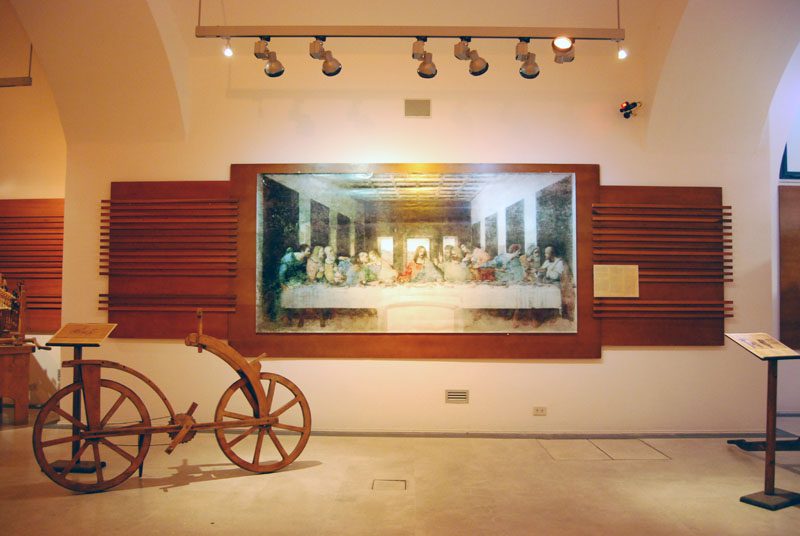
Experience interactive machines and inventions at the Leonardo Da Vinci Exhibition in Rome
Leonardo’s siblings and extended family
Leonardo had twelve paternal half-brothers and half-sisters and five maternal half-siblings. Ser Piero da Vinci married at least four times and had numerous legitimate children, some of whom are recorded with precise names and dates, including Antonio (1476), Maddalena (1477), Giuliano, Lorenzo, Violante, Domenico, Margherita, Benedetto, Pandolfo, Guglielmo, Bartolomeo and Giovanni. Leonardo’s mother, Caterina, had another five children: Piera, Maria, Lisabetta, Francesco and Sandra.
Leonardo’s relationships with his half-brothers and half-sisters appear to have been limited, partly because of the social and cultural distance between them. Leonardo became an artist, scientist and court figure, while his siblings remained more closely connected to family affairs and landed property. These differences became particularly evident during inheritance disputes, when Leonardo’s status as an illegitimate son partly excluded him from his father’s estate and led him to pursue legal action.
Leonardo da Vinci’s loves, children and friendships
Questions often arise about Leonardo da Vinci’s romantic life: did he ever have a wife, or did he ever fall in love? Leonardo’s private life has always been surrounded by mystery, and there is no evidence of an official romantic relationship, marriage or lasting partnership with a woman.
There is no record of Leonardo ever marrying or having children. However, he is known to have formed close bonds with his pupils and collaborators. One of the most important was Gian Giacomo Caprotti, known as Salaì, who entered Leonardo’s workshop in 1490 at around the age of ten. Over the course of their long association, he modelled for several works and became a kind of family figure in Leonardo’s household.
In one of his notes, Leonardo described him as “a thief, a liar, stubborn and greedy”, yet Salaì remained by his side for more than twenty-five years. The length and intensity of their bond have led some biographers to suggest a more intimate relationship, although no conclusive evidence supports this interpretation.
Another fundamental relationship was with Francesco Melzi, a young Milanese nobleman who became Leonardo’s pupil and faithful companion. Melzi accompanied him during the final years of his life in France and inherited his manuscripts and papers. After Leonardo’s death, he helped preserve and spread his ideas by collecting and organising part of his writings. Leonardo’s decision to entrust his notes to Melzi reveals the closeness of their bond, which resembled that of a father and son more than a conventional relationship between master and pupil.
Salaì and Melzi were undoubtedly the two people closest to Leonardo, but he also formed friendships with other assistants and collaborators, including Cesare da Sesto, Marco d’Oggiono, Giovanni Antonio Boltraffio and Tommaso Masini da Peretola, known as Zoroastro. The latter was both a friend and assistant who worked with Leonardo on experiments involving mechanics and anatomy.
How did Leonardo’s family influence him?
Leonardo grew up between two very different worlds: his mother’s humble rural background and his father’s educated, well-established Florentine family. This unique combination helped shape the way he observed and interpreted the world. His notebooks reveal the same careful attention to plants, animals, natural phenomena and the flight of birds as they do to architectural projects, engineering studies and scientific inventions.
Although being born out of wedlock affected Leonardo’s legal and social status, it did not prevent him from receiving an exceptional education. It was his father who introduced him to an artistic career around 1470 by taking him to the workshop of Andrea del Verrocchio in Florence, one of the most prestigious artistic studios of the time. There Leonardo trained alongside masters such as Botticelli, Perugino and Ghirlandaio, refining his artistic skills while developing the boundless curiosity that would later make him one of history’s greatest geniuses.
What is Leonardo da Vinci’s legacy?
When Ser Piero died in 1504, Leonardo was initially excluded from his father’s inheritance because he had been born outside marriage. The dispute resulted in legal proceedings that were settled two years later with a financial compensation granting him part of the estate. Following the death of his mother Caterina, Leonardo personally paid for her funeral expenses, a gesture that suggests the emotional bond between them had never been completely broken despite the years they had spent apart.
Leonardo da Vinci died in Amboise in 1519. After his death, his half-brothers claimed part of his material inheritance, while his manuscripts and notebooks were left to Francesco Melzi, who became the guardian of his intellectual legacy. This divided inheritance, with his material possessions passing to his biological family and his writings entrusted to his favourite pupil, perfectly reflects Leonardo’s dual identity: biologically connected to a large family, yet spiritually much closer to the disciples who shared his passion for knowledge and preserved his extraordinary work for future generations.
Leonardo Live
Visit the Leonardo Da Vinci Exhibition in Rome and discover his machines, inventions, and much more first-hand
This article was originally published in Italian on 05 August 2025
You can read the Italian version of this article here >