
Seven less touristy places to discover in Rome, from unusual museums and archaeology to surprising architecture and routes away from the best-known attractions.
Beyond the Colosseum, the Vatican Museums and the Trevi Fountain, Rome offers plenty of less touristy places that reveal a different side of the city. Small museums, art collections, underground archaeological sites and unusual architecture tell stories about the Italian capital that often go unnoticed on a first visit. You can admire a Roman statue next to the turbines of an old power station, step inside a villa decorated with stained glass and owls, discover an ancient apothecary or stroll among buildings that combine Art Nouveau, medieval and Art Deco elements. There is no need to venture far from the city centre: just a short walk from Piazza Navona, you can visit ancient Roman domus and, inside Palazzo della Cancelleria, discover Leonardo da Vinci’s inventions before descending to an archaeological site dating back to Roman times. Here are seven things to do in Rome to discover museums and lesser-known places.
TABLE OF CONTENTS
- Centrale Montemartini: Roman statues among turbines and engines
- Galleria Spada and Borromini’s perspective
- Casina delle Civette: a fairytale villa in Rome
- Ancient Apothecary of Santa Maria della Scala
- Roman Domus of Palazzo Valentini: beneath modern Rome
- Coppedè Quarter: a walk through an unusual side of Rome
- Leonardo da Vinci Exhibition: machines and archaeology in the heart of Rome
Centrale Montemartini: Roman statues among turbines and engines
Among Rome’s lesser-known museums, Centrale Montemartini is probably one of the most surprising. The building itself tells an important part of the city’s history, as the complex on Via Ostiense was originally built as a power station for the production of electricity and opened in 1912.
Its transformation into an exhibition space took place many decades later, when in 1997 some works from the Capitoline Museums were temporarily moved here while parts of the museum complex on the Capitoline Hill were being renovated.
The combination of archaeological collections and old industrial machinery proved so successful that it became permanent, and today statues, mosaics and artefacts from ancient Rome stand alongside turbines, engines and large industrial machines in the former power station. This contrast makes the visit particularly fascinating: on one side are traces of the ancient city, while on the other are the iron structures of a plant that tells the story of Rome’s industrial transformation during the 20th century.
Centrale Montemartini can therefore be a good alternative for those who love archaeology but are looking for something different from the major museums in the city centre, as well as a starting point for exploring the Ostiense district.
In Rome with Leonardo
Add the Leonardo Exhibition to your things to do in Rome
Galleria Spada and Borromini’s perspective
In the heart of Rome, not far from Campo de’ Fiori, there is a museum that can easily go unnoticed among the many attractions of the historic centre. Galleria Spada is housed in the 16th-century palace of the same name and preserves the art collection assembled mainly by Cardinals Bernardino and Fabrizio Spada between the 17th and 18th centuries. Its rooms contain paintings, sculptures and historic furnishings, with works by artists such as Guido Reni, Guercino, Orazio Gentileschi and Artemisia Gentileschi.
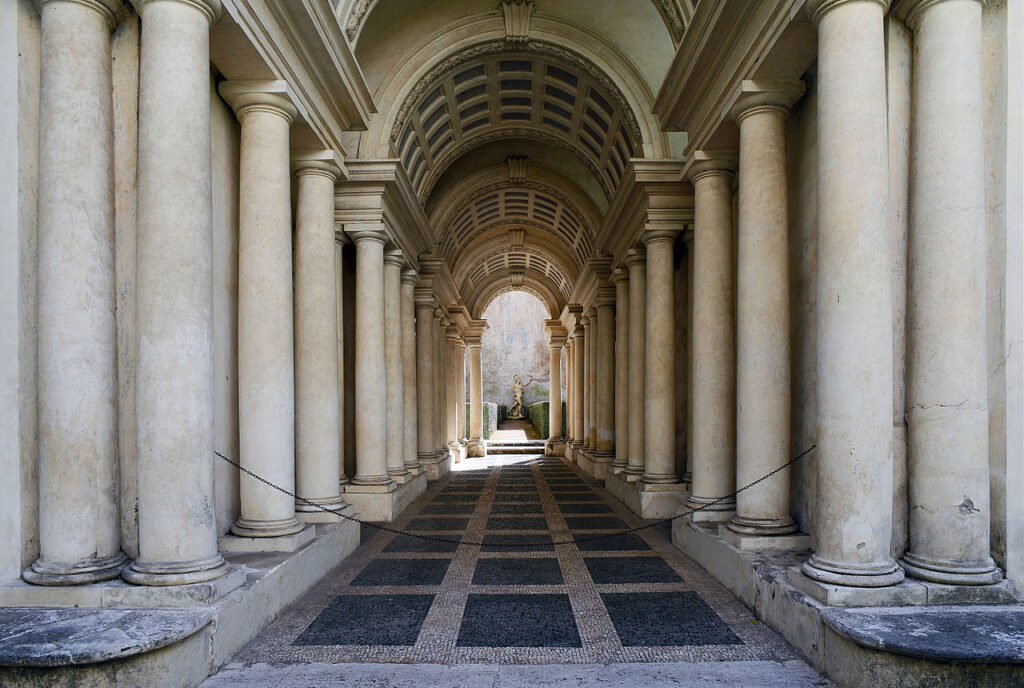
What makes it particularly worth including in an itinerary through unusual Rome, however, can be found in the courtyard, where Francesco Borromini created the famous Perspective Gallery in the 17th century, a small masterpiece of optical illusion. Thanks to the gradual reduction in the height of the vault, the rising floor and the columns that become progressively smaller, the corridor appears much longer than it actually is. The statue at the far end also contributes to the optical illusion: viewed from the entrance, it appears to be life-size, while in reality it is only about 60 centimetres tall.
The visit is relatively short, making it perfect even when exploring the historic centre of the Italian capital over a weekend or during a short stay.
Casina delle Civette: a fairytale villa in Rome
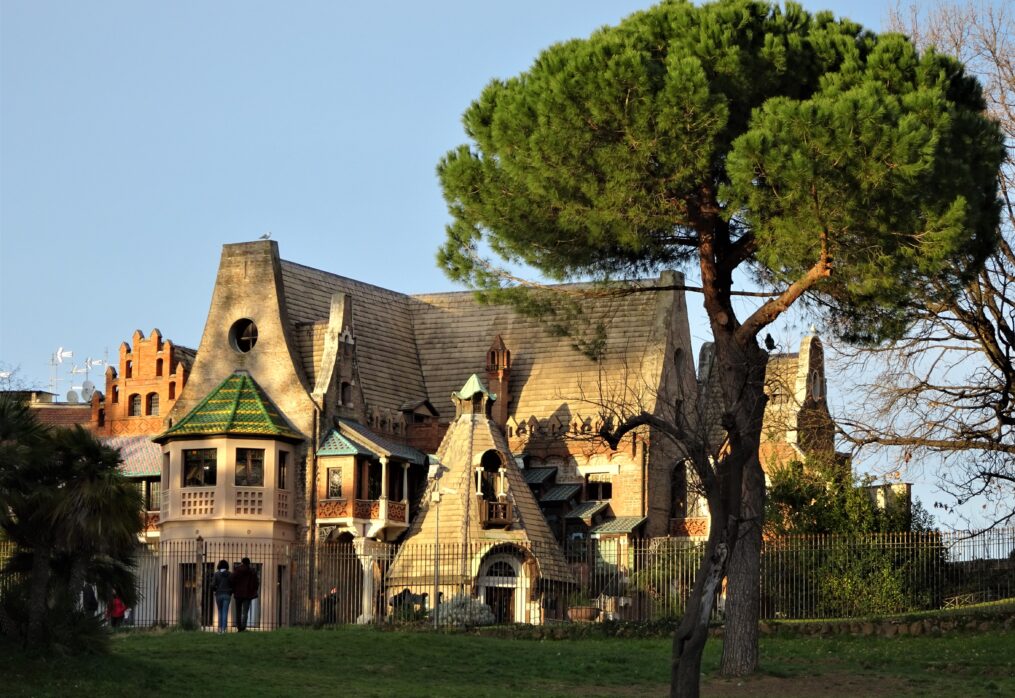
For a completely different atmosphere, inside Villa Torlonia you can find the Casina delle Civette, one of Rome’s most original buildings. Its history began in the 19th century, when Giuseppe Jappelli designed a rustic Swiss-style hut for Prince Alessandro Torlonia. Over the following decades, the building was extensively transformed until it acquired the imaginative appearance we see today, and it became the residence of Prince Giovanni Torlonia junior until his death in 1938.
Turrets, loggias, sloping roofs, majolica tiles, wrought iron and carved wood make the Casina look like a building from a fairytale, but it is above all the artistic stained-glass windows that characterise its interiors. Flowers, animals and geometric motifs appear in the decorations, together with the many depictions of owls that eventually gave the building its current name.
The visit is particularly interesting for those who love Art Nouveau and decorative arts, but it can also appeal to anyone simply looking for a place very different from the monumental, classical image normally associated with Rome. It is also worth exploring beyond the Casina itself: since it is located within Villa Torlonia, the visit can be combined with a walk through the park and a look at the other buildings in the complex, turning it into a pleasant few-hour stop away from the busiest areas of the city centre.
Ancient Apothecary of Santa Maria della Scala
In Trastevere you can find the Ancient Apothecary of Santa Maria della Scala, established within the convent of the Discalced Carmelites. Originally, its medicinal preparations were intended for the friars of the convent, but in the 17th century the apothecary was opened to the public and over time gained considerable fame, becoming traditionally known as the “pharmacy of the popes”.
The historic rooms still preserve shelves, pharmacy jars, mortars, stills and instruments used to prepare traditional remedies. They offer a glimpse of how an apothecary worked in centuries past, when medicinal herbs, resins, spices and other raw materials were processed directly in the laboratory to create medicinal preparations.
It is certainly a very unusual place, but it is currently temporarily closed to the public for restoration work. Before including it in an itinerary, it is therefore necessary to check whether it has reopened and what the new visiting arrangements are.
Roman Domus of Palazzo Valentini: beneath modern Rome
In Rome, descending just a few metres can often mean travelling many centuries back in time, as happens at several underground sites and beneath Palazzo Valentini, not far from Piazza Venezia and the Imperial Forums, where archaeological excavations have brought to light the remains of two large Roman domus from the Imperial period that belonged to high-ranking Roman families.
The Roman Domus itinerary allows visitors to see mosaics, floors, walls, thermal areas and other ancient structures through a tour that also uses multimedia reconstructions and projections to provide a better understanding of how the domus were built and lived in.
Lights and images help visitors recognise the different spaces and imagine the original appearance of the residences, making archaeological remains that might otherwise be difficult to interpret easier to understand.
The location is also excellent because, once back above ground, visitors find themselves in the heart of monumental Rome, just a few steps from Trajan’s Column. It is therefore an ideal stop for anyone exploring the historic centre who wants to discover what lies beneath the modern city.
Coppedè Quarter: a walk through an unusual side of Rome
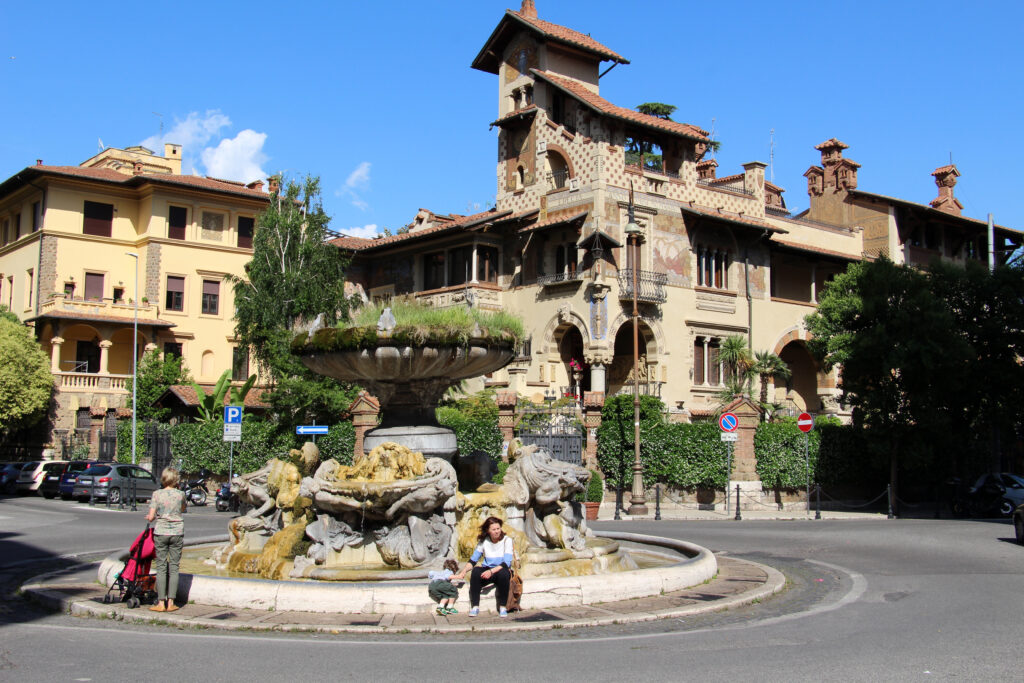
Between Via Salaria and Via Nomentana, you can stroll through the so-called Coppedè Quarter, which is not actually a real neighbourhood but a complex of 26 apartment buildings and 17 villas designed by Gino Coppedè and built between 1915 and 1927.
The walk ideally begins beneath the large arch connecting the Palazzi degli Ambasciatori, with an enormous wrought-iron chandelier hanging at its centre. A little further on is Piazza Mincio with the Fountain of the Frogs, surrounded by buildings where Art Nouveau and Art Deco elements blend with references to medieval, Renaissance and Baroque styles, and even the architecture of ancient Greece.
Among the buildings worth stopping to admire are the richly decorated Villino delle Fate and the Palazzo del Ragno, easily recognisable by the large spider depicted on its façade.
Coppedè does not require a long visit and can therefore be combined with other places in the area, such as the Casina delle Civette. Together, the two sites make it possible to create a short itinerary dedicated to early 20th-century Rome and its most imaginative architecture, completely different from the classic walk among Roman ruins and Baroque churches.
Leonardo da Vinci Exhibition: machines and archaeology in the heart of Rome
Even in the heart of the historic centre, it is possible to choose an experience that is different from the capital’s major museums. At Palazzo della Cancelleria, just a few steps from Campo de’ Fiori and Piazza Navona, the Leonardo da Vinci Exhibition offers an itinerary dedicated to the inventions, studies and many interests of the Renaissance genius.
The visit offers the opportunity to see up close several working machines built on the basis of the designs contained in Leonardo’s codices, making it possible to discover the mechanisms and principles studied by the artist. The exhibition also explores the different fields that captured Leonardo’s curiosity, from flight and mechanics to anatomy and botany, highlighting the constant relationship between art, science and the observation of nature.
However, the visit has another surprise in store beneath Palazzo della Cancelleria. Descending below the current level of the city, visitors reach the tomb of Aulus Hirtius, Julius Caesar’s lieutenant and Roman consul who died at the Battle of Mutina in 43 BC. The funerary monument, discovered in 1938, is partly submerged in the waters of the ancient Euripus, the canal that once crossed this area of the Campus Martius.
In the same place, it is therefore possible to move from Renaissance inventions to archaeological evidence of ancient Rome, hidden beneath one of the great palaces of the historic centre. And perhaps it is precisely this layering that best captures the fascination of Rome’s less touristy places: even just a few steps from attractions visited by thousands of people every day, choosing a different doorway or descending a few metres underground is enough to discover another chapter in the city’s history.
A Unique Idea for Your Visit
For a different kind of experience in Rome, explore the interactive Leonardo da Vinci Exhibition
You can read the Italian version of this article here >