
Leonardo da Vinci lived alongside Salaì for more than twenty-five years. Pupil, model and perhaps lover, the rebellious young man became the face of several famous works and the most enigmatic companion of Leonardo’s life.
Among the many mysteries surrounding the life of Leonardo da Vinci, the one concerning his closest personal relationships remains one of the most debated. The Renaissance genius never married or had children, choosing instead to devote his life to art, science and the pursuit of knowledge. Yet by his side, for more than twenty-five years, was a strikingly handsome and rebellious young man: Gian Giacomo Caprotti, known as Salaì. Their relationship, marked by curious episodes and possible references within Leonardo’s paintings, has led many to wonder whether Salaì was not only Leonardo’s pupil but also his lifelong companion.
TABLE OF CONTENTS
- Who was Gian Giacomo Caprotti, known as Salaì?
- Was Salaì Leonardo’s lover?
- The accusations of sodomy against Leonardo
- The clues in Leonardo’s works
- Why did Leonardo leave part of his estate to Salaì?
- What do scholars say?
Who was Gian Giacomo Caprotti, known as Salaì?
Gian Giacomo Caprotti was born in Oreno, near Vimercate, around 1480 and entered Leonardo’s workshop in 1490 when he was only ten years old. Leonardo nicknamed him Salaì, meaning “little devil”, because of his rebellious nature and constant mischief. Giorgio Vasari described him as a handsome and charming young man who was also inclined to steal money and clothes.
Salaì spent much of his life with Leonardo, remaining at his side for more than twenty-five years and following him from Milan to Florence and later to France. This is particularly significant because relationships between masters and apprentices were usually temporary. In this case, however, the extraordinary duration of their bond suggests a relationship that may have gone far beyond artistic training.
Inside Leonardo’s World
Experience interactive machines and inventions at the Leonardo Da Vinci Exhibition in Rome
Was Salaì Leonardo’s lover?
Salaì was far more than one of Leonardo’s pupils. He played a central role in the master’s life, serving as his assistant and probably also as one of his favourite models. Many scholars recognise his features in the soft, sensual face of Saint John the Baptist and in the drawing known as the Incarnate Angel, now in the Louvre, one of Leonardo’s most daring and suggestive works.
Some even believe that Salaì’s features inspired the mysterious face of the Mona Lisa or Monna Vanna, a nude version of the famous portrait that exists in several variants, including one associated with Salaì. In these works, his androgynous beauty, suspended between masculine and feminine traits, seems to embody Leonardo’s ideal of beauty, reflected in his fascination with ambiguous and mysterious figures.
Based on these artistic clues, together with documentary evidence and Leonardo’s will, some historians have suggested that their relationship extended beyond art. Nevertheless, there is no definitive proof that Leonardo and Salaì were romantically involved.
The accusations of sodomy against Leonardo
When Leonardo was a young man, he and several others were accused of sodomy, although the case was dismissed without conviction. This episode has fuelled the belief that Leonardo may have been homosexual while choosing to keep his private life discreet.
Some details suggest a particularly close bond with Salaì, including the fact that Leonardo kept him constantly by his side, the young man’s enduring presence within his closest circle, the exceptional length of their relationship and Leonardo’s decision to leave him part of his estate. Even so, the idea that Salaì was Leonardo’s lover remains only a hypothesis, as no historical source explicitly states that they were lovers.
The clues in Leonardo’s works
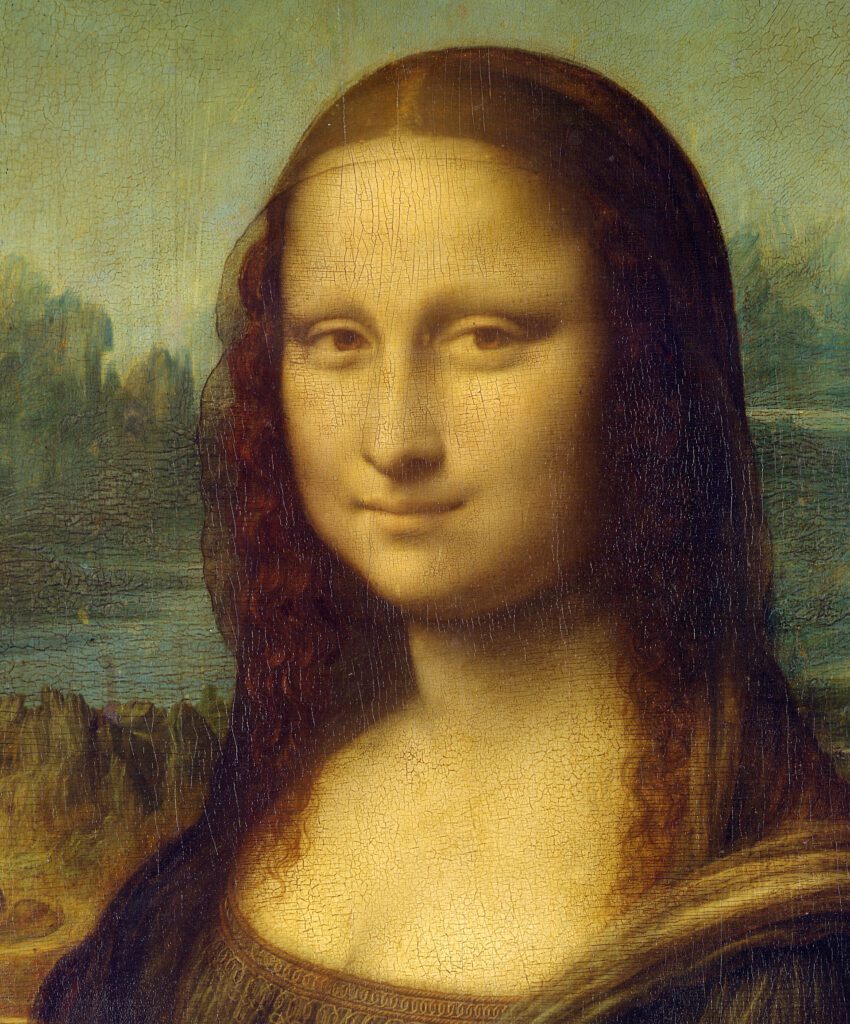
Speculation about a possible romantic relationship between Leonardo and Salaì has also been fuelled by details that some believe can be found in Leonardo’s artworks. In the Mona Lisa, for example, some researchers claim to see two tiny letters in the subject’s eyes, an S and an L, corresponding to the initials of Salaì and Leonardo.
Other theories concern erotic drawings attributed to Leonardo that appear to depict homoerotic scenes. These works remain controversial: while some scholars consider them authentic, others believe they were produced by followers or added at a later date.
Why did Leonardo leave part of his estate to Salaì?
When Leonardo died in 1519, most of his estate was left to his pupil Francesco Melzi. Salaì, however, also inherited paintings and property and, according to some sources, even the Mona Lisa.
This decision confirms the importance of their relationship and suggests that Salaì had become almost a member of Leonardo’s family, regardless of whether their bond was romantic. Leonardo could easily have distanced himself from Salaì, who was often considered unreliable, yet he never did. Instead, he ensured that Salaì would remain part of his legacy and his final wishes.
What do scholars say?
Most historians approach the subject with caution because there is no direct evidence of a romantic relationship between Leonardo and Salaì. Some interpret the erotic drawings attributed to Leonardo as evidence of a homosexuality lived discreetly, while others consider them nothing more than anatomical studies. Documentary sources, from Vasari to Lomazzo, all acknowledge Salaì’s importance in Leonardo’s life, but none clearly defines the nature of their relationship.
What is beyond doubt is that Salaì was one of the most enduring and significant figures in Leonardo’s life and that, without him, our image of the Renaissance genius would be far less complex and intriguing. Whether they were lovers, however, remains an unconfirmed hypothesis.
Leonardo Live
Visit the Leonardo Da Vinci Exhibition in Rome and discover his machines, inventions, and much more first-hand
This article was originally published in Italian on 1 July 2025
You can read the Italian version of this article here >