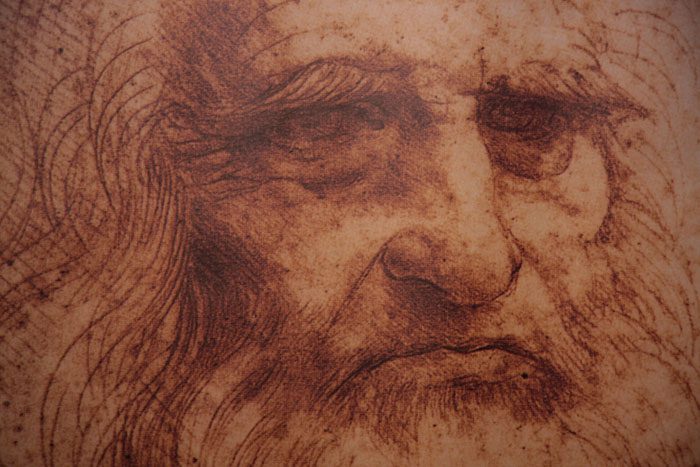

From the real meaning of “da Vinci” to his war machines with deliberate flaws: 10 surprising facts that reveal a more human and mysterious side of Leonardo.
Leonardo da Vinci is one of the most fascinating figures in history, yet behind the image of the Renaissance genius there are still many surprising details waiting to be discovered. Here are ten interesting facts about Leonardo that reveal some of the lesser-known aspects of his life: from the true meaning of his name and his family background to his personal choices, from the reason why he wrote backwards to his remarkable insights into the sky and trees, as well as his views on religion and other little-known curiosities.
TABLE OF CONTENTS
- What was Leonardo’s surname?
- What secrets surround Leonardo’s family?
- Was Leonardo married?
- Why did Leonardo write backwards?
- Why is Leonardo’s “rule of trees” still studied today?
- How did Leonardo explain why the sky is blue?
- What did Leonardo study?
- Did Leonardo believe in God?
- Was Leonardo a vegetarian?
- Was Leonardo a pacifist or an inventor of weapons?
1. What was Leonardo’s surname?
Leonardo did not have a surname in the modern sense of the word. His full name was Leonardo di ser Piero da Vinci, meaning “Leonardo, son of Ser Piero, from Vinci”.
The words da Vinci simply indicated his place of origin. Contemporary documents never refer to him as “Leonardo Vinci” or “Mr Da Vinci”, as might happen if he had been born today.
This reminds us that Leonardo was a man of the fifteenth century, whose identity was closely linked to his family and his hometown long before his fame turned him into a universal icon.
Inside Leonardo’s World
Experience interactive machines and inventions at the Leonardo Da Vinci Exhibition in Rome
2. What secrets surround Leonardo’s family?
Leonardo was born on 15 April 1452 in Anchiano, a hamlet near Vinci, to Piero, a notary, and Caterina, a young peasant woman. He was born out of wedlock, a condition that prevented him from holding certain public offices but also gave him an unusual degree of freedom for his time.
Since he was not expected to follow his father’s profession, Leonardo was able to devote himself to the arts and was sent to the workshop of Andrea del Verrocchio, where he studied painting, sculpture and mechanics.
This unconventional upbringing may have contributed to his independent spirit and boundless curiosity, allowing him to change direction freely and abandon one project in pursuit of another. These characteristics have led some modern authors to speculate that he may have had ADHD, although they could just as easily have been shaped by his unique family circumstances.
3. Was Leonardo married?
Leonardo never married and had no children, dedicating almost his entire life to art, scientific research and his pupils.
At a time when marriage was considered almost inevitable, his decision to remain unmarried reflects his desire to live without family obligations and to devote himself entirely to the pursuit of knowledge.
His choice has nevertheless fuelled centuries of speculation about his private life, including the suggestion that Gian Giacomo Caprotti, known as Salaì, may have been his lover.
4. Why did Leonardo write backwards?
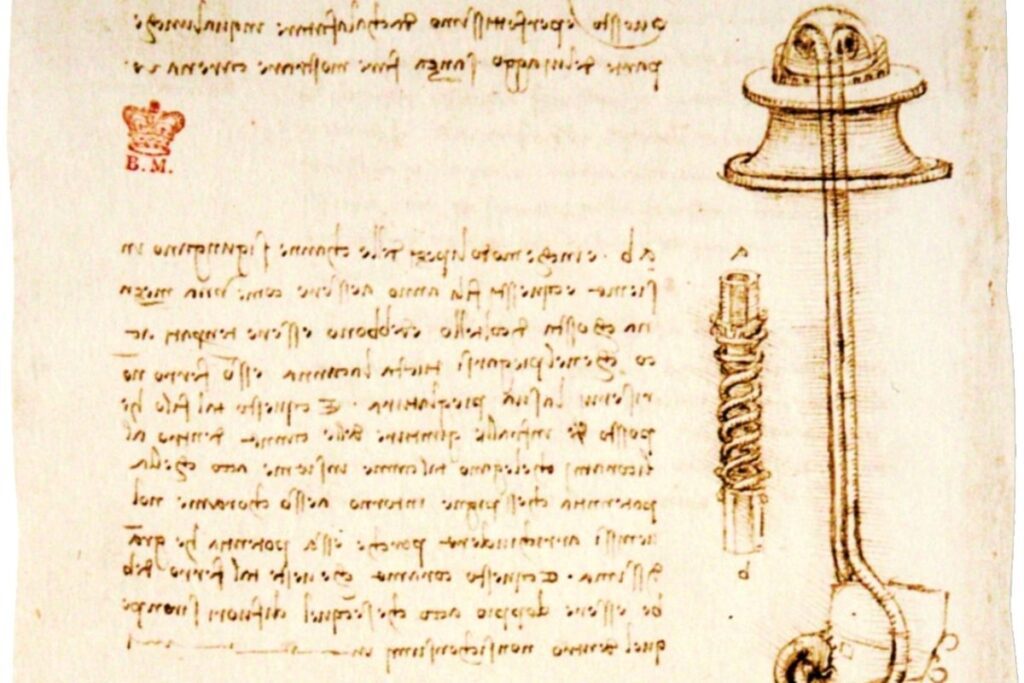
Leonardo is famous for his mirror writing, which runs from right to left. For many years it was believed that he wrote this way to protect his notes from curious readers, but the simplest and most widely accepted explanation is that he was left-handed and found this method more practical because it prevented him from smudging the ink.
This unusual habit has made Leonardo’s notebooks even more fascinating, turning them into remarkable works in which text and drawings blend together in a single, harmonious composition.
5. Why is Leonardo’s “rule of trees” still studied today?
Leonardo was a keen observer of nature, botany and animals. He noticed that whenever a branch divides, the combined cross-sectional area of the smaller branches is equal to that of the main branch.
This principle, now confirmed by scientific research, is known as Leonardo’s rule and explains how trees distribute sap while maintaining their ability to withstand the forces of the wind.
In his notebooks, Leonardo drew detailed sketches of trunks and branching patterns, revealing an almost engineering-like approach to the study of nature. His ability to move from careful observation to the formulation of general principles makes him a forerunner of modern biology and ecology.
6. How did Leonardo explain why the sky is blue?
Leonardo was one of the first people to propose a remarkably accurate explanation for the colour of the sky. In his notes, he wrote that blue was not an inherent colour of the sky itself, but the result of sunlight being scattered through the atmosphere.
This was an extraordinary insight for its time and anticipated Rayleigh’s theory of light scattering by several centuries. Leonardo’s curiosity about seemingly ordinary natural phenomena reveals the scientific method that guided his work: observation, hypothesis and verification, much like the approach followed by scientists today.

7. What did Leonardo study?
Unlike many educated men of his time, Leonardo never attended university. His education was practical, largely self-taught and driven by personal curiosity.
Remarkably, Leonardo taught himself by reading, observing and experimenting. Free from academic constraints, he was able to combine disciplines such as art, engineering, anatomy and botany, constantly moving from one field of knowledge to another.
This versatility, what we would now call an interdisciplinary approach,is one of the reasons why Leonardo is regarded as the perfect embodiment of the Renaissance polymath.
8. Did Leonardo believe in God?
Leonardo was a rational thinker, deeply fascinated by the laws of nature, and his writings contain relatively few expressions of religious devotion. Nevertheless, he believed in a universal order that could be understood through careful observation. Shortly before his death in Amboise, he received the Christian sacraments and, according to Giorgio Vasari, expressed regret that he had not devoted more of his talent to sacred art.
This detail adds another layer to Leonardo’s personality, suggesting that after spending a lifetime seeking answers through science, he wished to end his life by reconciling himself with spirituality as well.
9. Was Leonardo a vegetarian?
According to some historical sources, Leonardo was a vegetarian or at least avoided eating meat a highly unusual choice in the fifteenth century.
Some biographers recount that he bought caged birds simply to set them free, an act that reflects an exceptional sensitivity towards animals for his time. If these accounts are accurate, they further support Leonardo’s ethical and naturalistic view of the world: humanity was not the master of nature, but an integral part of it.
10. Was Leonardo a pacifist or an inventor of weapons?
Leonardo’s writings include passages in which he condemns the cruelty of war, describing it as “a most bestial madness”. Yet he is equally famous for designing military machines, including armoured vehicles, multi-barrel weapons and movable bridges.
Was he therefore a pacifist, or did he support warfare? Historians have noted that many of his military designs contain technical flaws that would have made them difficult, if not impossible, to build. Some have suggested that Leonardo introduced these errors deliberately as a form of ethical sabotage, intended to prevent his inventions from being used on the battlefield.
Leonardo was probably a realist. He accepted commissions to design military machines because they offered protection and financial support from powerful patrons, while at the same time maintaining a critical and deeply moral attitude towards violence.
Leonardo Live
Visit the Leonardo Da Vinci Exhibition in Rome and discover his machines, inventions, and much more first-hand.
This article was originally published in Italian on 21 September 2025
You can read the Italian version of this article here >