

From the Vitruvian Man to the geometric solids drawn for Luca Pacioli: Leonardo da Vinci used mathematics and geometry to study the human body, art and the natural world.
What is the relationship between Leonardo da Vinci and geometry? In his studies, subjects such as mathematics, geometry and art constantly intersect. Leonardo measured the human body, studied proportions, used perspective to represent space and drew complex geometric solids for the mathematician Luca Pacioli. The most famous example is, of course, the Vitruvian Man, in which the human body is placed within a circle and a square according to the proportions described by the Roman architect Vitruvius. Over time, Leonardo’s proportions have given rise to interpretations that are not always accurate, particularly regarding the golden ratio. To understand where facts end and legends begin, it is therefore necessary to take a closer look at his drawings and at the relationship Leonardo established between geometry, proportion, art and the representation of reality.
TABLE OF CONTENTS
- Why Leonardo da Vinci studied geometry
- The Vitruvian Man and the proportions of the human body
- Circle and square: the geometry of the Vitruvian Man
- Did Leonardo da Vinci really use the golden ratio?
- Leonardo, Luca Pacioli and De divina proportione
- When geometry becomes art
- Leonardo da Vinci’s science at the Rome Exhibition
Why Leonardo da Vinci studied geometry
For Leonardo, geometry was not an abstract subject separate from other disciplines, but a tool for observing, measuring and representing reality. This approach is clearly reflected in his manuscripts, in which words, calculations and drawings are constantly used together to investigate a wide range of phenomena.
Mathematics made it possible to identify ratios and proportions, while geometry was essential for representing shapes, volumes and objects in space. Leonardo therefore used plans, sections, perspective and three-dimensional representations in his studies of architecture, mechanics and engineering.
His interest in these disciplines grew particularly during the years he spent in Milan, where he also came into contact with Luca Pacioli, one of the most important mathematicians of the Renaissance. Their encounter gave Leonardo the opportunity to explore mathematical and geometric questions that could be applied both to artistic representation and scientific study. The Leonardo da Vinci National Museum of Science and Technology documents precisely this close relationship between drawing, geometry and representation in Leonardo’s method.
Inside Leonardo’s World
Experience interactive machines and inventions at the Leonardo Da Vinci Exhibition in Rome
The Vitruvian Man and the proportions of the human body
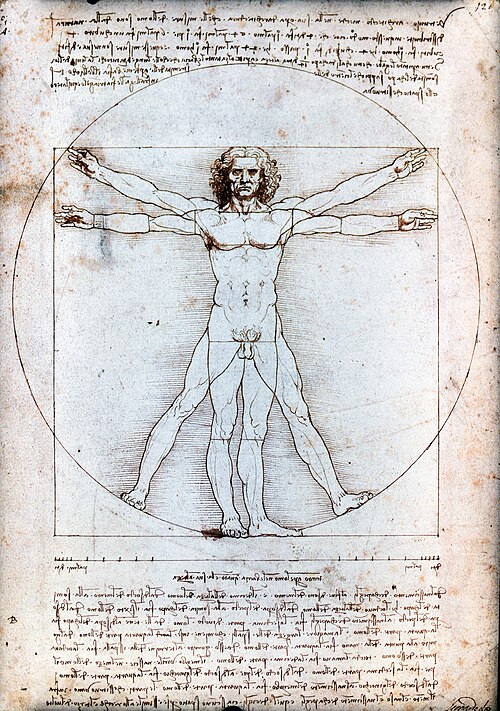
The most famous example of the connection between geometry and anatomy is the Vitruvian Man, drawn by Leonardo around 1490 and now preserved at the Gallerie dell’Accademia in Venice.
To create it, Leonardo started from the principles described in De architectura by the Roman architect Vitruvius, according to whom the harmonious proportions of buildings should be modelled on the proportions of the human body.
He then studied the body using a series of ratios between its different parts, such as the span of the arms, which corresponds to the height of the person. The face, hands, feet and other parts of the body are also related to the overall height.
The Vitruvian Man is the result of studies combining anatomy, geometry, architecture and direct observation, which Leonardo used to understand the structure of the human body and represent it graphically.
Circle and square: the geometry of the Vitruvian Man
Another distinctive feature of the Vitruvian Man is the presence of the circle and the square, two fundamental geometric shapes in which Leonardo superimposes two different positions of the same body, with the arms and legs arranged differently, managing to inscribe the figure within both shapes.
In the Vitruvian Man, the circle and the square do not have the same centre, since the centre of the circle is located at the navel, as indicated by the Vitruvian tradition, while the centre of the square is positioned lower down. Leonardo thus manages to reconcile the proportions of the body with two different geometric constructions without distorting the human figure.
For a student, the drawing is an excellent example of how geometry can move beyond the pages of a mathematics textbook and become a useful tool for describing something real such as the human body.
Did Leonardo da Vinci really use the golden ratio?
When discussing Leonardo and mathematics, the golden ratio almost inevitably comes up. This particular proportion is now represented by the Greek letter φ (phi) and has an approximate value of 1.618. Over time, the golden ratio has been identified in many works of art and is often associated with the Vitruvian Man as well.
Pacioli’s work uses the term divine proportion, which does indeed refer to the mathematical ratio we now call the golden ratio. The fact that Leonardo illustrated the treatise suggests that he was certainly familiar with mathematical questions concerning proportion, but this does not prove that the Vitruvian Man was intentionally constructed according to the golden ratio, nor does it allow this mathematical ratio to be attributed to Leonardo’s works in general.
Leonardo’s true relationship with proportions may therefore be less mysterious and instead lie in measuring and comparing in order to find an underlying order in the phenomena he observed.
Leonardo, Luca Pacioli and De divina proportione
The most concrete connection between Leonardo and mathematics can be found in his relationship with Luca Pacioli, whom he met in Milan at the end of the 15th century.
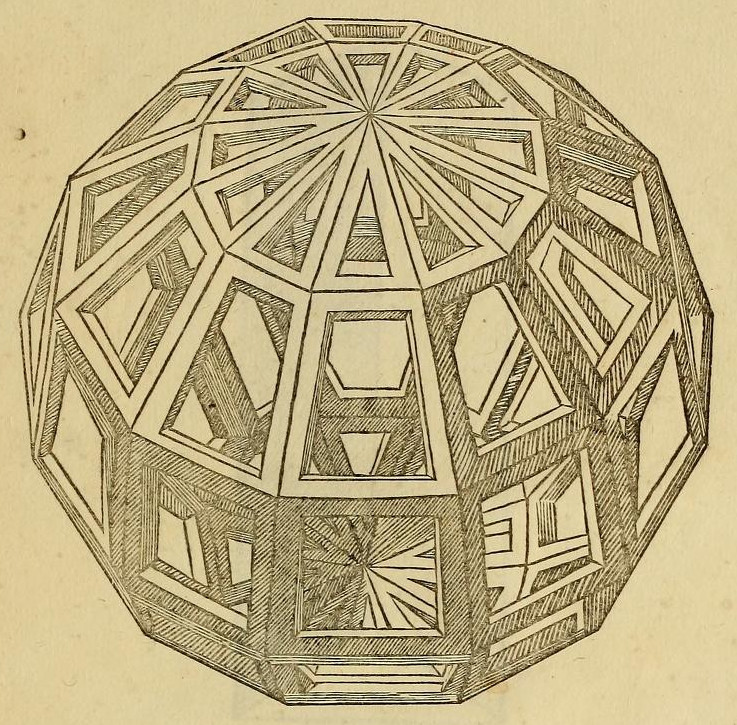
For De divina proportione, Leonardo produced a series of drawings of polyhedra and complex solids, including forms related to the Platonic solids, using a particularly effective graphic solution.
Some are represented as solid bodies, while others appear as structures formed only by their edges: in the latter case, it is possible to see at the same time even the parts that would normally be hidden behind the surfaces. They can be considered a kind of Renaissance equivalent of a three-dimensional geometric model used to understand how a solid is constructed. This is particularly interesting for students learning geometry today, as it shows how a complex figure can become easier to understand when it is represented in the right way. It is no coincidence that the Leonardo da Vinci National Museum of Science and Technology considers these plates a significant milestone in the perspective representation of solids.
The manuscript was completed in 1498, and the work was later published in Venice in 1509. The Metropolitan Museum of Art holds a copy of the printed edition containing figures derived from Leonardo’s drawings.
When geometry becomes art
For Leonardo, geometry and mathematics were also tools for representing space in painting, because perspective makes it possible to convey the perception of depth on a two-dimensional surface.
One of the clearest examples is the Last Supper, where the painted architecture visually extends the real space of the refectory of Santa Maria delle Grazie. The perspective lines organise the scene and lead the viewer’s gaze towards the figure of Christ, positioned at the centre of the composition.
Here, the relationship between art and mathematics becomes easier to understand, because it clearly shows how geometry provides an artist with tools to construct space, organise figures and guide the viewer’s gaze. Art and science, which today are often studied as separate subjects, constantly come together in Leonardo’s work.
Discover Leonardo da Vinci’s science at the Rome Exhibition
The relationship between drawing, geometry and design can also be explored from a different perspective at the Leonardo da Vinci Exhibition at Palazzo della Cancelleria, in the centre of Rome.
The exhibition features working machines built from the drawings contained in Leonardo’s codices, allowing visitors to see in three dimensions mechanisms that appear on the surface of a page in his manuscripts. Gears, movements and structures provide a practical understanding of the importance of form, proportion and representation in the transition from an idea to a project.
For this reason, the visit can be particularly interesting for students, teenagers and families: many concepts that are studied separately at school in mathematics, art, technology, history and science can all be found in the work of a single person.
Leonardo Live
Visit the Leonardo Da Vinci Exhibition in Rome and discover his machines, inventions, and much more first-hand.
You can read the Italian version of this article here >