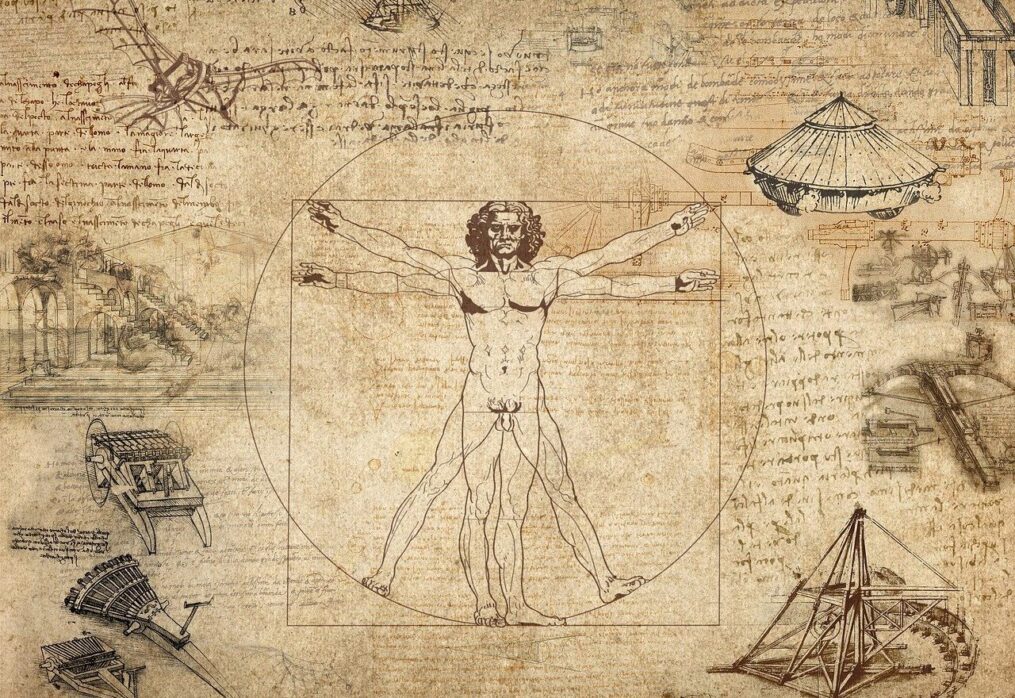

Leonardo da Vinci’s codices and notebooks preserve his thinking in action: drawings, studies and insights that reveal one of the most forward-thinking minds of the Renaissance.
Leonardo da Vinci’s codices and notebooks are perhaps the most fascinating part of his legacy, as they reveal not only his work but also his thinking in action. More than seven thousand pages have survived, scattered across museums and collections around the world, preserving sketches, notes, observations, calculations, reflections and scientific insights. These pages allow us to imagine Leonardo as he reasoned, experimented and questioned how the world worked. Rather than finished treatises, they are fragmentary and spontaneous in nature, resembling a continuous laboratory of ideas in which drawings and words intertwine to explore life, nature, movement, the human body and the mind.
TABLE OF CONTENTS
- The secret world of Leonardo’s codices
- What do Leonardo’s codices contain?
- Where are Leonardo’s codices kept?
- Leonardo’s method revealed through his notebooks
- Why Leonardo’s codices are still relevant today
The secret world of Leonardo’s codices
Leonardo’s codices are personal notebooks that were not intended to be read by others, but were used to record his thoughts and ideas. Many of Leonardo’s notes were written in his famous mirror writing, a form of backwards writing that runs from right to left. Leonardo often used this method for convenience, as he was left-handed, but possibly also to maintain a degree of privacy over what he recorded.
Unlike other artists of his time, who often produced organised journals or workshop manuals, Leonardo wrote down anything that caught his attention and inspired him to investigate further, whether it was the movement of water, a muscle, a face, the flight of birds or a sudden idea.
Leonardo’s codices therefore offer an unfiltered glimpse into his mind, with pages unfolding like an inner dialogue made up of drawings, diagrams, observations and hypotheses that rarely reach a definitive conclusion. For this reason, da Vinci’s codices provide the most authentic insight into his working methods and his understanding of the world.
Inside Leonardo’s World
Experience interactive machines and inventions at the Leonardo Da Vinci Exhibition in Rome
What do Leonardo’s codices contain?
The codices do not follow a linear structure, as Leonardo did not approach knowledge in a fixed order. Instead, he moved naturally from one subject to another, convinced that everything was interconnected. Their pages therefore contain anatomical studies, including remarkably detailed dissections, alongside designs for hydraulic machines, mills, pumps and canals. Leonardo’s codices also include notes on the flight of birds, the proportions of the human body, light, shadows, perspective, the movement of water, atmospheric phenomena, plants and minerals.
Leonardo’s notes also contain philosophical reflections and investigations into language, musical harmony and geometry. Throughout these pages, we can see how the Renaissance genius attempted to develop a unified understanding of knowledge, reflecting his belief that the laws governing the human body were similar to those controlling the flow of rivers or the growth of plants. The codices therefore form a multidisciplinary universe, a mosaic of insights revealing how Leonardo was simultaneously an artist, scientist, naturalist and inventor.
Where are Leonardo’s codices kept?
Leonardo’s codices are now scattered across various collections around the world, following centuries of dispersal, sales and the division of manuscripts. The largest and most famous is the Codex Atlanticus, housed in the Biblioteca Ambrosiana in Milan. It consists of more than a thousand sheets covering subjects ranging from mathematics and mechanics to botany and cartography. It is the richest and most comprehensive collection, offering a fascinating journey into the mind of the genius.
Another important collection is the Windsor Drawings, held by the Royal Collection Trust. These include some of Leonardo’s most remarkable anatomical studies, such as his famous drawing of a foetus in the womb, his investigations into the heart and his illustrations of the movement of muscles and bones.
The Codex Arundel, held at the British Library, contains notes on mechanics, geometry, perspective and philosophical observations. The Codex Leicester, formerly known as the Codex Hammer and now owned by Bill Gates, focuses primarily on water, fluid dynamics, light and geology. This manuscript is particularly fascinating because it reveals Leonardo exploring the science of the Earth long before geology developed as a discipline.
Other manuscripts and drawings are held in Turin, Florence, Paris and Madrid, as well as in private collections. Each codex represents a fragment of Leonardo’s thinking, offering a window into a different aspect of his research.

Leonardo’s method revealed through his notebooks
Leonardo da Vinci’s notebooks clearly reveal his method: observe, draw and verify. For Leonardo, there was no separation between images and knowledge, because drawing was a way of thinking. His pages show how he developed an idea through successive sketches, each more precise than the last, until he understood its underlying structure.
Leonardo was guided by doubt rather than certainty. He therefore wrote and drew to examine phenomena from different perspectives, formulate hypotheses, challenge theories and rebuild them on more solid foundations.
His notebooks are a laboratory of the mind, revealing not a search for absolute truths but a method of approaching them through direct experience. In this way, Leonardo anticipated modern science while remaining firmly rooted in his own time, emerging as an experimental thinker who used drawing as a scientific tool.
Why Leonardo’s codices are still relevant today
Reading Leonardo’s codices today means encountering a way of thinking that feels remarkably contemporary. His pages resemble the notebooks of a modern researcher, filled with open questions, insights, diagrams, experiments and analogies.
Their relevance lies not only in their technical content, much of which anticipated later discoveries, but also in Leonardo’s vision of nature as a system, knowledge as a process and art as a form of scientific investigation.
Scholars still consult Leonardo’s codices to understand the origins of many modern ideas and to admire the work of a mind that was never afraid to explore, while artists regard them as an example of boundless creativity. The codices are Leonardo’s most enduring legacy, demonstrating that free and curious thinking never grows old.
Leonardo Live
Visit the Leonardo Da Vinci Exhibition in Rome and discover his machines, inventions, and much more first-hand
This article was originally published in Italian on 18 November 2025
You can read the Italian version of this article here >