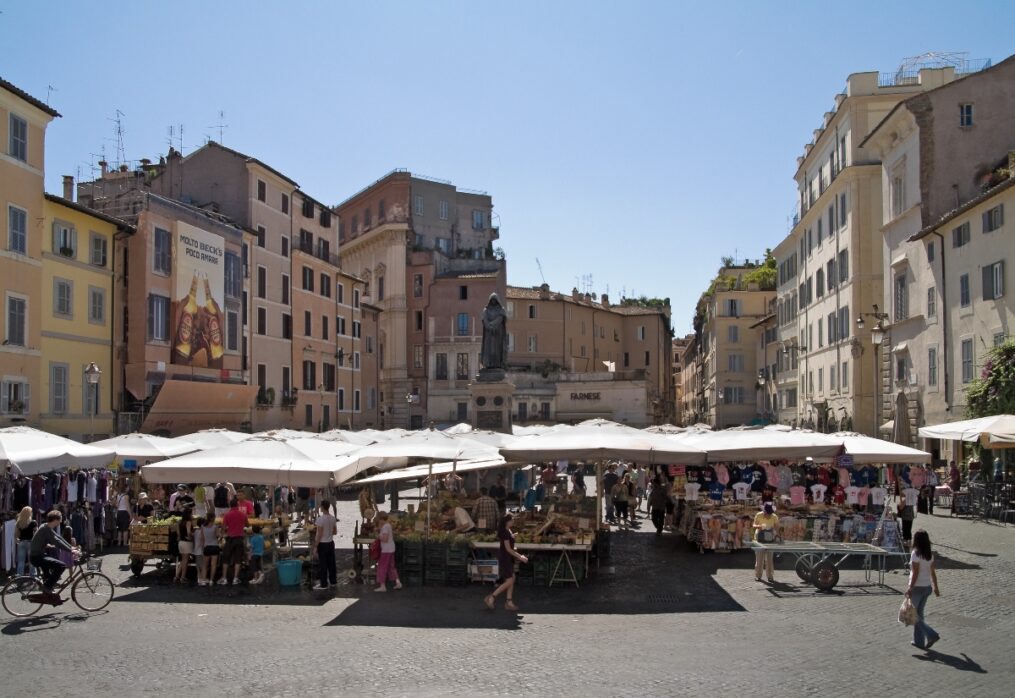

What to see near Campo de’ Fiori: a walking itinerary through palaces, art, Roman remains, perspective illusions and unusual places.
Renaissance palaces, perspective illusions, remains of ancient Rome and small hidden passageways: around Campo de’ Fiori in Rome, you can plan a walking itinerary packed with things to do but different from the usual route between the city’s most famous attractions and monuments. Starting from the square, it takes just a few minutes to reach Palazzo della Cancelleria, discover a Roman tomb hidden beneath the building, see the ancient basins in Piazza Farnese and be deceived by Borromini’s perspective at Palazzo Spada. Continuing towards Via Giulia, you will come across an unfinished project by Michelangelo and a church with a decidedly unusual history, before returning towards Campo de’ Fiori through the Passetto del Biscione. The route takes you through more than two thousand years of Rome’s history, while rarely requiring you to walk more than a few hundred metres between stops, so it is also suitable if you do not have much time to explore the city.
TABLE OF CONTENTS
- Campo de’ Fiori and the story of Giordano Bruno
- Palazzo della Cancelleria and the hidden Roman tomb
- Piazza Farnese and the basins from the Baths of Caracalla
- Galleria Spada and Borromini’s perspective illusion
- Via Giulia and Michelangelo’s unfinished project
- Santa Maria dell’Orazione e Morte
- Passetto del Biscione and a Roman curiosity
Campo de’ Fiori and the story of Giordano Bruno
The itinerary begins right in Campo de’ Fiori, one of the best-known squares in central Rome. Today, the square is best known for its market and the many bars and restaurants surrounding it, but its history also reveals some decidedly less carefree aspects of the Italian capital.
In the past, the square was used for public executions, and it was here, on 17 February 1600, that the philosopher Giordano Bruno, condemned for heresy, was burned at the stake. At the centre of the square today stands a monument depicting Bruno facing the Vatican, created by Ettore Ferrari and inaugurated in 1889.
Another curiosity connected with the square is its fountain, which is now in a different location after being moved to make room for the monument to Giordano Bruno. In 1590, Giacomo Della Porta created a basin that was also used by market traders to wash fruit and vegetables and keep them cool. In the 17th century, it was covered with a large travertine lid, and Romans nicknamed it the “Terrina” because of its resemblance to a soup tureen.
In Rome with Leonardo
Add the Leonardo Exhibition to your things to do in Rome
Palazzo della Cancelleria and the hidden Roman tomb
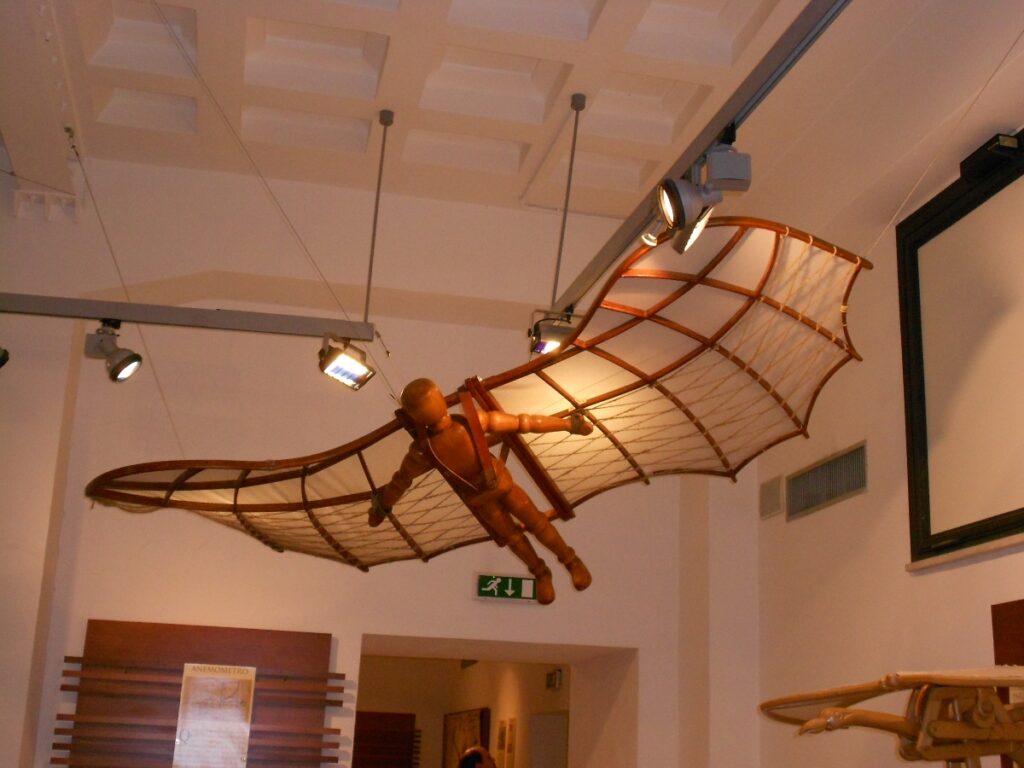
Just a few steps from Campo de’ Fiori is Palazzo della Cancelleria, a large Renaissance building that today also houses the Leonardo da Vinci Exhibition, where visitors can see working machines built from the drawings contained in Leonardo’s codices.
As well as exploring the inventions, studies and interests of the Renaissance genius, a visit to the exhibition reveals an unusual surprise beneath the palace. In the underground area lies the tomb of Aulus Hirtius, Roman consul and lieutenant of Julius Caesar who died in 43 BC during the War of Mutina against Mark Antony. The tomb was discovered in 1938 and is now largely submerged in the waters of the ancient Euripus, a canal that crossed the Campus Martius before reaching the Tiber.
The archaeological monument is included in the Leonardo da Vinci Exhibition itinerary, making it possible to move, within the same building, from the studies of one of the leading figures of the Renaissance to a surviving trace of Rome from the 1st century BC.
Piazza Farnese and the basins from the Baths of Caracalla
Just a few steps from Palazzo della Cancelleria, the atmosphere changes completely as you reach Piazza Farnese, dominated by the imposing Palazzo Farnese, which was designed and built by some of the greatest architects of the Renaissance, including Antonio da Sangallo the Younger and Michelangelo.
Before looking at the palace, however, it is worth stopping to admire the two large fountains in the square, with granite basins that came from the ancient Baths of Caracalla.
One of the two was moved to the square in the first half of the 16th century, while the second basin arrived a few decades later. They were then transformed into fountains in the 17th century, making them one of the many examples in Rome of ancient materials being reused centuries later, incorporating fragments of the Roman city into the Renaissance and Baroque landscape.
Galleria Spada and Borromini’s perspective illusion
Continuing towards Piazza Capo di Ferro, you reach Galleria Spada, a small museum housing a collection of Baroque paintings and one of Rome’s most surprising optical illusions, an example of how art, geometry and perspective can be used to alter the perception of space.
In the Secret Garden is the famous Perspective Gallery by Francesco Borromini, created in 1653 with the help of mathematician Giovanni Maria da Bitonto. Viewed from the front, it appears to be a long colonnade, but the gallery is actually less than nine metres long.
The effect is created through a precise geometric construction in which the columns gradually become smaller and move closer together, while the floor rises and the vault descends towards the far end. The statue at the end of the gallery, which appears to be normal-sized when viewed from a distance, is actually much smaller than the eye perceives it to be.
Via Giulia and Michelangelo’s unfinished project
From Galleria Spada, you can continue towards Via Giulia, the long street commissioned by Pope Julius II at the beginning of the 16th century, which is still one of the most atmospheric walks in Rome’s historic centre.
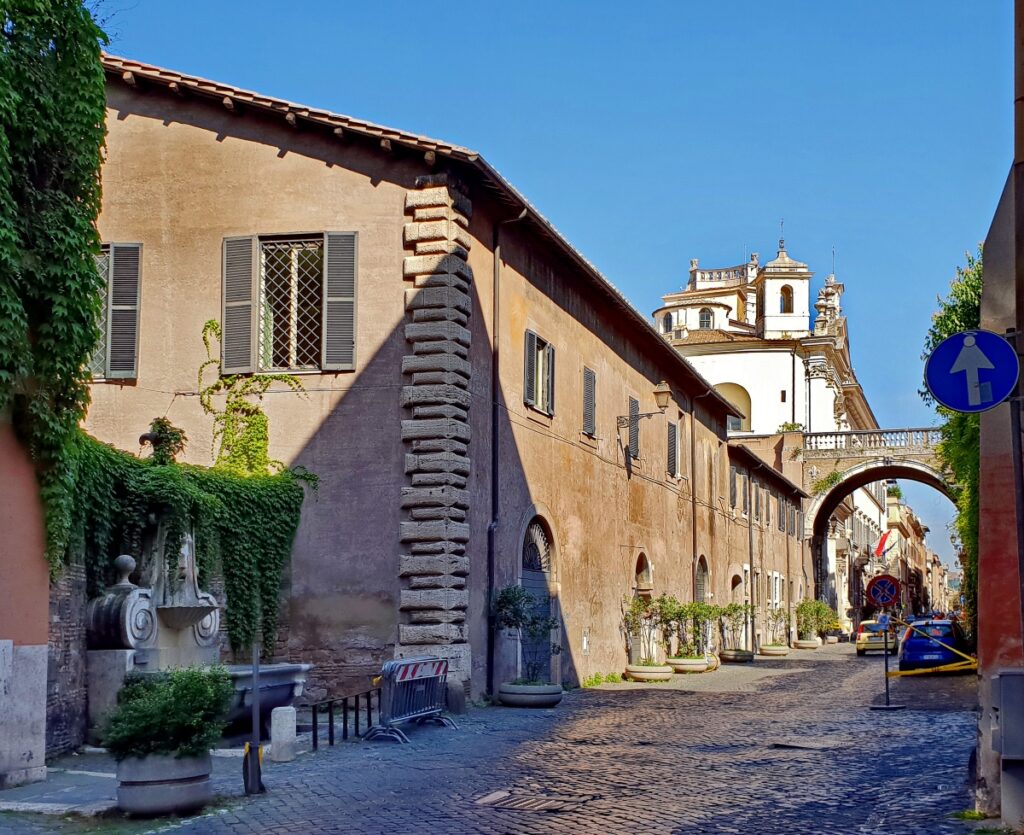
One of the most curious features along the way is the Farnese Arch, a passage spanning the street beside the gardens of Palazzo Farnese.
It is a small surviving trace of an ambitious project that was never completed, based on Michelangelo’s idea of connecting Palazzo Farnese with the family’s properties on the other side of the Tiber, where Villa Farnesina stood.
Santa Maria dell’Orazione e Morte
Not far from the Farnese Arch is a church whose very name hints at its rather unusual history: Santa Maria dell’Orazione e Morte.
The church was associated with the confraternity of the same name, founded in the 16th century with the task of collecting and giving a proper burial to abandoned bodies, including those found in the countryside around Rome or recovered from the waters of the Tiber. Near the church there was also a large cemetery, partly underground and partly overlooking the river, which almost completely disappeared with the construction of the Tiber embankments at the end of the 19th century.
Looking at the exterior, you can see symbols associated with death, reflecting the original role of the confraternity. It is a brief but significant stop, as it reveals aspects of everyday life in Rome’s past that rarely emerge along the classic tourist routes.
Passetto del Biscione and a Roman curiosity
To complete the itinerary, you can return towards Campo de’ Fiori through the Passetto del Biscione, a small covered passage connecting Via di Grotta Pinta with Piazza del Biscione, which in ancient times linked the cavea of the Theatre of Pompey with the outside.
An image of the Madonna della Misericordia by Scipione Pulzone, dating from the 16th century and now preserved in the church of San Carlo ai Catinari, was also kept here. According to tradition, the difficulty of finding this image of the Madonna hidden among the narrow streets and the passage gave rise to the Roman expression “andare a cercare Maria per Roma”, literally “to go looking for Mary around Rome”, used to describe a particularly difficult search.
Leaving the Passetto, you find yourself practically back at the starting point, completing a route that, within just a few hundred metres, has crossed ancient Rome, the Renaissance and the Baroque, taking you from a submerged Roman tomb to an unfinished project by Michelangelo, from a perspective illusion to one of the most hidden passageways in the historic centre, beyond the best-known sights.
A Unique Idea for Your Visit
For a different kind of experience in Rome, explore the interactive Leonardo da Vinci Exhibition
You can read the Italian version of this article here >