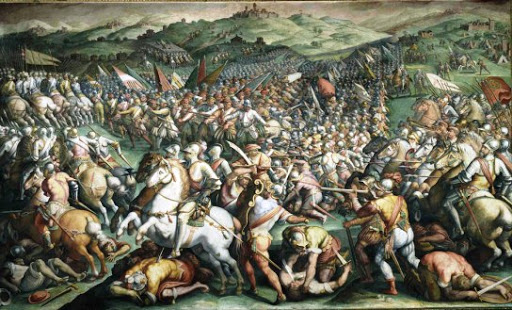

Leonardo’s Battle of Anghiari: failed experiments, famous copies, modern theories and documents confirming its execution.
The famous fresco by Leonardo, commissioned for the Hall of the Five Hundred, remained shrouded in mystery for centuries: was it ever actually painted? Is it hidden behind a work by Vasari? The myth of the Battle of Anghiari remains one of the most fascinating chapters in art history and was long surrounded by mystery. Recent research, however, has concluded that Leonardo never completed the work. Despite evidence relating to expenses, payments and the purchase of materials, it appears that Leonardo did not have the pigments needed to create it. The project therefore never progressed beyond the preparatory cartoons, and the mural painting was never actually produced.
TABLE OF CONTENTS
- An ambitious undertaking between politics and art
- The cartoon and the copies that preserved its memory
- The mystery of its disappearance and modern theories
- A myth that has survived through time
An ambitious undertaking between politics and art
In 1503, Florence was experiencing a crucial moment in its history: the Republic, eager to celebrate its military victories and assert the city’s political greatness, decided to decorate the Hall of the Great Council, now known as the Hall of the Five Hundred, with two grand pictorial cycles, entrusting them to two of the most celebrated artists of the time.
For the decoration of the Hall’s immense walls, Leonardo was commissioned to create the Battle of Anghiari, while Michelangelo was assigned the Battle of Cascina. This decision transformed the hall into an ideal arena in which the two giants of the Renaissance would compete not only through painting, but also with the pride and expectations of an entire city.
Leonardo approached the undertaking with the desire to overcome the limitations of the traditional fresco technique, which he considered incapable of conveying the vitality and energy of a battle scene. He therefore opted for an innovative method inspired by encaustic painting, mixing oil-based colours on a preparation of plaster and wax and attempting to fix them to the wall using the heat of braziers. It was a bold idea, worthy of his experimental spirit, but one that was soon destined to end in failure.
According to contemporary accounts, the colours began to run down the wall, damaging the work while it was still being executed and forcing a disappointed Leonardo to abandon the project, leaving it unfinished.
Inside Leonardo’s World
Experience interactive machines and inventions at the Leonardo Da Vinci Exhibition in Rome
The cartoon and the copies that preserved its memory
Although Leonardo’s fresco did not survive, the preparatory cartoon became a masterpiece in its own right, displayed in Florence and admired by artists and citizens alike, to the point that it was described as a “school of the world”, serving as a model for generations of painters. The scene of the “Fight for the Standard”, at the centre of the composition, was particularly striking for its dramatic intensity and the violence of its gestures.
The most famous of the copies derived from it is the one by Rubens, created in the 17th century and now at the Louvre, which conveys at least some of the energy of the original project.
Other painters, such as Lorenzo Zacchia and Bastiano da Sangallo, also drew inspiration from it, helping to preserve the image of a work that many considered the most powerful depiction of a battle ever conceived during the Renaissance.
The mystery of its disappearance and modern theories
In the 16th century, Giorgio Vasari renovated the Hall of the Five Hundred and created new celebratory frescoes. His intervention erased every visible trace of Leonardo’s work, but over time a legend emerged that Vasari, who admired the master, had chosen not to destroy his work completely, but instead to protect it behind a new wall.
Support for the hypothesis that the Battle of Anghiari was actually executed also came from the research of Johannes Wilhelm Gaye, a German art historian who explored the Florentine archives during the first half of the 19th century. In his Carteggio inedito d’artisti dei secoli XIV, XV e XVI, published in 1840, Gaye included a long list of accounting documents dating from Leonardo’s time.
These are records of payments and expenses of the Florentine Republic documenting payments to Leonardo and his collaborators, purchases of materials and work notes relating both to the preparatory phase in Santa Maria Novella and to the work in the Hall of the Great Council. These documents appear to show that the works were not merely planned but were actually begun, with workers and resources employed on site. Considering the list of materials, work and payments, the question of whether the work was actually executed was therefore raised once again.
In the early 2000s, Professor Maurizio Seracini revived the hypothesis that the work had been “protected” by Vasari. Scientific investigations using radar, thermography and microcameras appeared to confirm the presence of a painted layer behind Vasari’s fresco, revealing pigments compatible with those used by Leonardo. The lack of conclusive evidence, however, brought the research to a halt, leaving the question unresolved.
Subsequently, some scholars concluded that Leonardo never actually painted the wall, limiting himself to preliminary experiments, and that the Battle of Anghiari was therefore not lost, but simply never completed as a mural.
Following extensive research coordinated by the Department of Architecture at the University of Florence, researchers concluded that the painting was only commissioned to Leonardo at the beginning of the 16th century and that he was supplied with only some of the materials, but not the pigments needed to paint the wall.
Thanks to this study, which also examined documents dating from the years between 1503 and 1506, it is now thought that the preparatory cartoons Leonardo had produced at the convent of Santa Maria Novella were studies for a work that was, in fact, never actually executed.
A myth that has survived through time
Whether the Battle of Anghiari was painted and subsequently lost, or remained unfinished from the outset, its cultural legacy has never faded. The expressive power of the preparatory cartoon, the admiration of contemporary artists, the copies produced over the following centuries and recent technological investigations have all contributed to a myth that continues to fascinate historians, scholars and visitors today.
It is not simply a matter of reconstructing the story of a lost fresco, but of understanding how a work, even through its absence, can become a symbol of an era, a reflection of a city’s ambitions and of the genius of an artist who never ceases to surprise us.
Leonardo Live
Visit the Leonardo Da Vinci Exhibition in Rome and discover his machines, inventions, and much more first-hand
This article was originally published in Italian on 14 July 2025
You can read the Italian version of this article here >