
Leonardo da Vinci’s works are among the most treasured achievements in art history, not only for their beauty but also for what they reveal about his way of thinking. Leonardo was not a prolific artist, and relatively few works can be attributed to him with certainty. Yet each one contains an entire world of observations, studies, revisions and insights that bring science and painting together. His paintings combine anatomy, optics, the psychology of the gaze, the mathematics of perspective and an almost spiritual sensitivity to the inner lives of his subjects. Alongside his completed masterpieces are unfinished works, abandoned paintings and experiments that never reached their final form, as well as a number of lost works that have fuelled the legend of the Renaissance genius for centuries. Understanding Leonardo’s works means exploring his mind, his methods and his remarkable ability to observe and reinterpret reality through drawing, materials and light.
TABLE OF CONTENTS
- What are Leonardo da Vinci’s works?
- Leonardo’s unfinished works: why did he never complete them?
- Leonardo’s lost works: what do we know?
- What painting techniques did Leonardo use?
- Drawing as an art form
What are Leonardo da Vinci’s works?
Only a small number of works can be attributed to Leonardo with certainty, but each one reflects his approach to observation, research and invention.
During his early years in Verrocchio’s workshop, Leonardo painted the Annunciation and contributed to the Baptism of Christ. These works already reveal a new sensitivity to light, subtle tonal transitions and distant landscapes that seem to breathe with life.
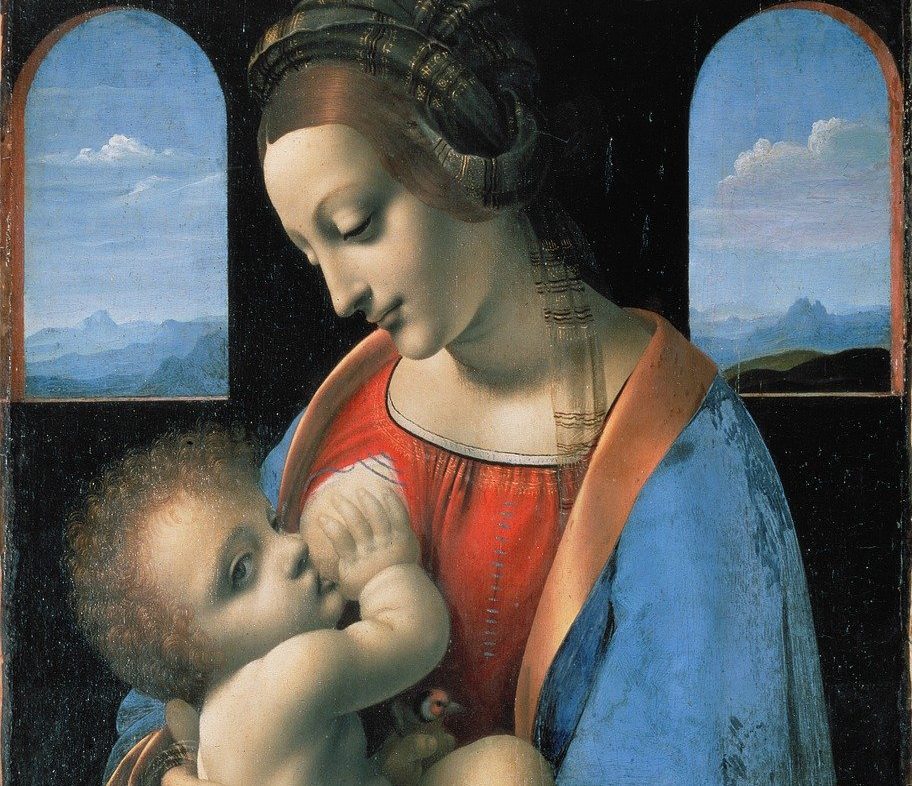
The Madonna of the Carnation, painted in the following years, already demonstrates Leonardo’s distinctive ability to combine psychology and naturalism, giving his figures a sense of life and inner emotion.
The Adoration of the Magi, which remained unfinished, is one of his most fascinating projects. Its chaotic movement, ruined architecture and intense expressions reveal his desire to understand not only how to represent the world, but also how it works.
The two versions of the Virgin of the Rocks, one at the Louvre and the other at the National Gallery, demonstrate his ability to revisit and refine his ideas and techniques. The first, more mysterious and atmospheric, and the second, clearer and more defined, illustrate the evolution of his artistic language.
In portraits such as Lady with an Ermine and La Belle Ferronnière, Leonardo achieved a psychological depth that was virtually unparalleled at the time. Rather than simply posing, the figures seem to be captured in a moment of thought, a breath or a subtle movement.
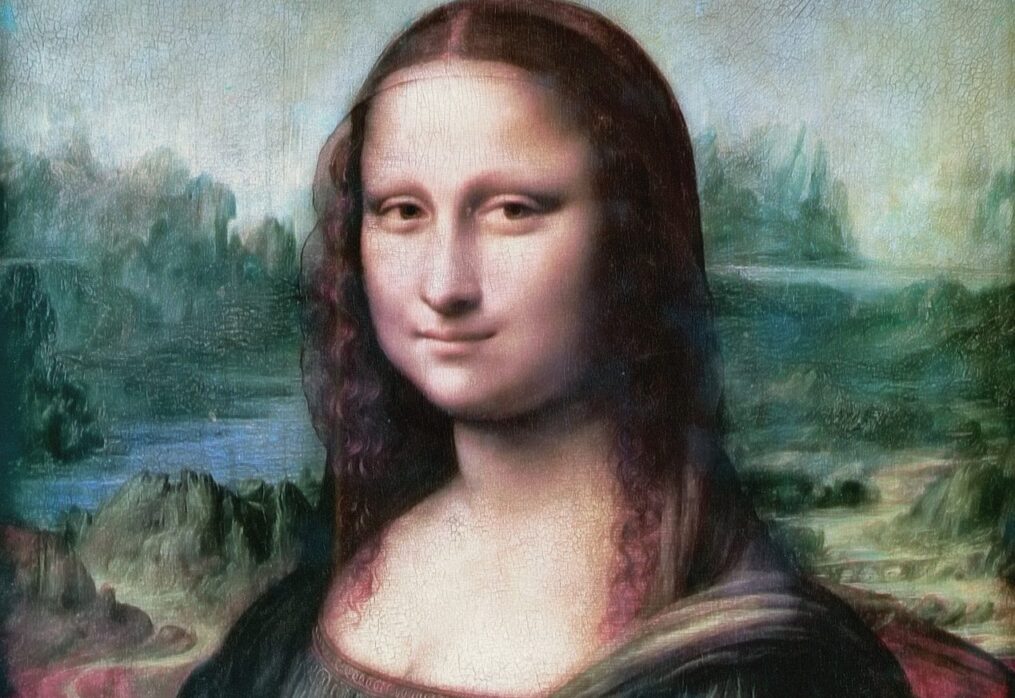
The Mona Lisa is, of course, the culmination of this exploration. It is not merely a portrait, but a visual enigma created through countless delicate layers of translucent paint, with a geological landscape framing the face like a parallel world.
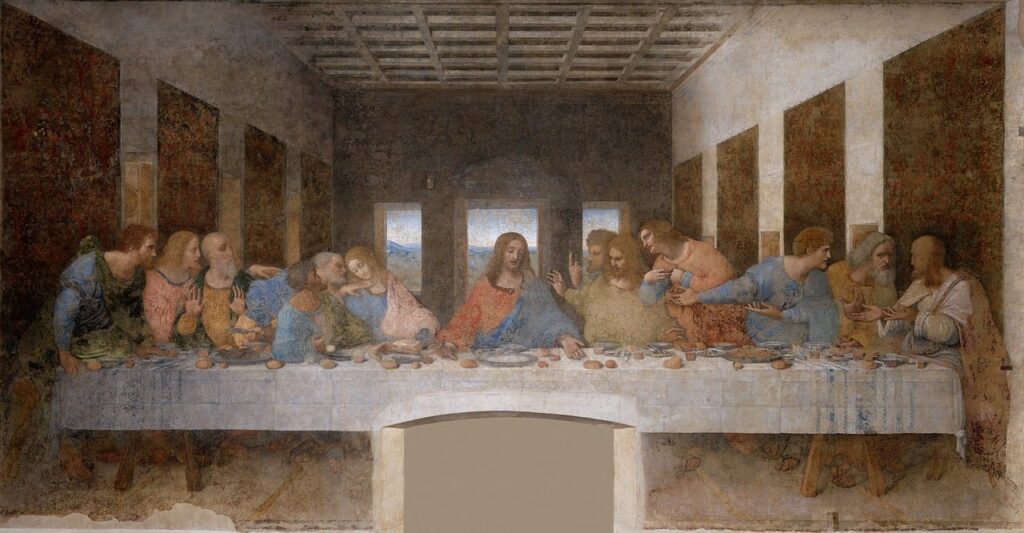
The Last Supper, painted in the refectory of Santa Maria delle Grazie, is a revolutionary work that was already at risk of being lost just a few decades after its completion. Leonardo chose an unconventional technique that allowed him to work slowly, as though painting on a wooden panel, but left the surface extremely fragile. The result is a dramatic, theatrical scene in which each apostle reacts differently to Christ’s words, with the collective emotional response portrayed with extraordinary precision.
Leonardo’s later works, produced during his final years in Milan and France, such as Saint John the Baptist and The Virgin and Child with Saint Anne, reveal an artist increasingly interested in dissolving outlines, exploring the effects of light and taking painting into a more imaginative and visionary realm. Finally, works such as Salvator Mundi remain controversial and are not universally accepted as being entirely by Leonardo’s hand. Nevertheless, their study, regardless of attribution, has helped shed light on how Leonardo and his workshop operated, sharing drawings, models and creative ideas.
Inside Leonardo’s World
Experience interactive machines and inventions at the Leonardo Da Vinci Exhibition in Rome
Leonardo’s unfinished works: why did he never complete them?
Leonardo’s reputation as an artist who left his works unfinished is linked both to his perfectionism and his insatiable curiosity. Leonardo was more interested in the creative process than the final result. For him, a work of art was not simply something to complete and deliver, but an opportunity for continuous exploration, a kind of intellectual laboratory. He worked with great intensity but quickly lost interest, leaving projects unfinished to pursue whatever fascinated him at the time. As a result, many of his works remained incomplete, suspended like visual notes. This tendency has also given rise to the hypothesis that Leonardo may have had ADHD.
Among Leonardo’s unfinished works is Saint Jerome in the Wilderness, housed in the Vatican Museums. The painting depicts a thin, tormented figure emerging from a composition that is only roughly outlined, yet already remarkably powerful.
The Adoration of the Magi, commissioned by the monks of San Donato a Scopeto, was also abandoned when Leonardo decided to move to Milan. Its complex composition reflects Leonardo’s way of thinking, as though he wanted to understand every aspect of the scene before even beginning to paint it. This may have been another reason why he often struggled to finish what he started.
La Scapigliata, generally considered to be by Leonardo’s own hand, is another striking example of his unfinished style. It depicts an exceptionally delicate face emerging from a rough, unfinished surface, like a thought that has not yet fully taken shape.
Finally, another unfinished work by Leonardo is the Battle of Anghiari, an ambitious mural project for the Salone dei Cinquecento in Florence, which was interrupted when the experimental technique he employed began to fail. His attempts to develop a modern form of encaustic painting did not produce the desired results, and the painting soon deteriorated.
Leonardo’s lost works: what do we know?
Alongside his unfinished works, there is an entire chapter of Leonardo’s work that has been lost. Some pieces are shrouded in mystery, others are mentioned in historical sources but have never been found, while others survive only through copies. One of the best-known examples is Leda and the Swan, a painting highly admired by Leonardo’s contemporaries but now lost. Surviving copies depict a graceful, intricately posed figure, entirely consistent with Leonardo’s fascination with the movement of the human body.
Another famous example is the so-called Nude Mona Lisa, a drawing that may have been produced within Leonardo’s circle and which some studies have linked to the anatomical models explored during the creation of the Mona Lisa.
Other lost works are known through 16th-century inventories that mention portraits and paintings of the Madonna which can no longer be identified. These missing works contribute to the air of mystery surrounding Leonardo, demonstrating how what has been lost can often be just as fascinating as what has survived.
What painting techniques did Leonardo use?
Leonardo’s painting techniques were central to his innovations. His scientific approach to representation led him to experiment constantly, often achieving extraordinary results, although some of his methods also posed risks to the long-term preservation of his works.
His signature technique was sfumato, which creates almost imperceptible transitions between tones, giving faces a sense of inner life that seems to pulse beneath the skin. Leonardo observed that nature has no sharp outlines and that everything gradually blends and dissolves into light. This understanding gave rise to a style characterised by soft, enveloping shadows and subtle, atmospheric effects.
Perspective was equally fundamental. Leonardo understood that distance alters both colour and clarity, which is why mountains in his landscapes take on bluish tones, the atmosphere appears translucent and the light changes across different layers of the composition. This creates a sense of naturalistic depth that was unprecedented at the time. Chiaroscuro, meanwhile, was not merely a technical device for Leonardo but also a narrative tool, allowing him to model forms, direct the viewer’s attention and create atmosphere.
Another essential element was Leonardo’s knowledge of anatomy. His studies included the skeleton, tendons and muscles, giving him the accuracy needed to portray poses, movements and gestures naturally and convincingly. Leonardo’s experiments with materials and paint mixtures also caused many of his works to deteriorate over time, as demonstrated by The Last Supper, which was painted on a wall using techniques unsuitable for plaster.
Drawing as an art form
For Leonardo, drawing was not simply a preparatory tool but a way of expressing his intelligence and thought processes. Through drawing, Leonardo explored, analysed and sought to understand human anatomy, the movement of water, the forces that allow birds to fly, and the laws governing the animal and plant kingdoms.
Leonardo’s drawings reveal both scientific precision and artistic sensitivity, as well as a mind almost obsessively devoted to understanding nature and how it moves and changes. His sketches reflect curiosity, investigation and independent thought. Some of his drawings, such as the Burlington House Cartoon and the Head of a Young Girl in Turin, appear to be complete works of art in their own right rather than preliminary sketches or exercises.
Leonardo Live
Visit the Leonardo Da Vinci Exhibition in Rome and discover his machines, inventions, and much more first-hand
This article was originally published in Italian on 21 November 2025
You can read the Italian version of this article here >