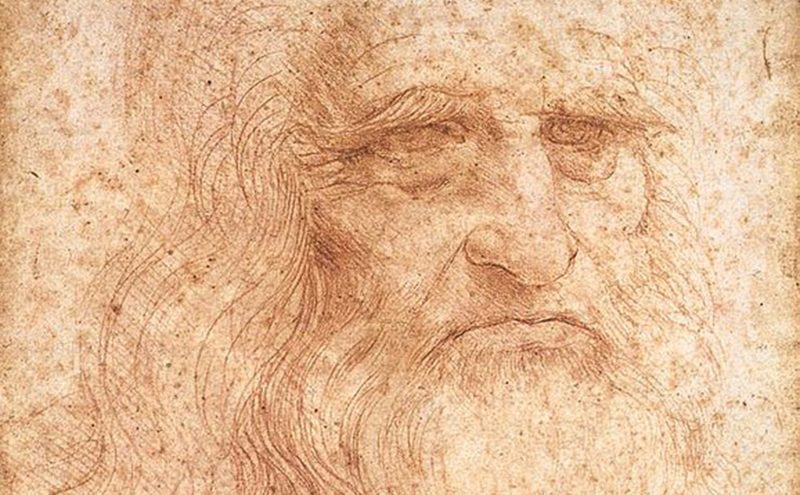

The famous drawing is traditionally considered a self-portrait of Leonardo da Vinci, but the identity of the man depicted remains a subject of debate.
Does Leonardo da Vinci’s self-portrait really depict Leonardo? The famous drawing shows an elderly man with long hair, a flowing beard and an intense gaze, features that have helped shape the image of the Renaissance genius as we imagine him today. The work is known worldwide as Leonardo’s Self-Portrait, but there is no conclusive evidence that the man depicted is actually the artist. His identity remains a subject of debate among art historians, particularly because of uncertainties surrounding the drawing’s date and the apparent age of the subject. Some scholars believe Leonardo portrayed himself in the final years of his life, while others suggest that the drawing is simply a study of an elderly man’s face. Despite these uncertainties, the Portrait of an Old Man has become an iconic image, widely circulated through engravings, publications and reproductions that have helped make it the most recognisable portrait of Leonardo da Vinci.
TABLE OF CONTENTS
- What does Leonardo’s self-portrait look like and where is it kept?
- Does the self-portrait really depict Leonardo?
- What evidence suggests that the man depicted is Leonardo?
- How the Portrait of an Old Man became the face of Leonardo da Vinci
What does Leonardo’s self-portrait look like and where is it kept?
The drawing known as Leonardo da Vinci’s Self-Portrait is kept at the Royal Library of Turin and is one of the most famous works in the Leonardo collection of the Royal Museums. Also known as the Portrait of an Old Man, the drawing measures approximately 33 centimetres in height and 21 centimetres in width and was created in red chalk, a drawing technique that uses a reddish material to create lines and shading on paper.
The drawing is particularly delicate, as the paper shows signs of deterioration and oxidation that require careful conservation. For this reason, the original is not normally on permanent display but is shown to the public only on selected occasions and under special conditions.
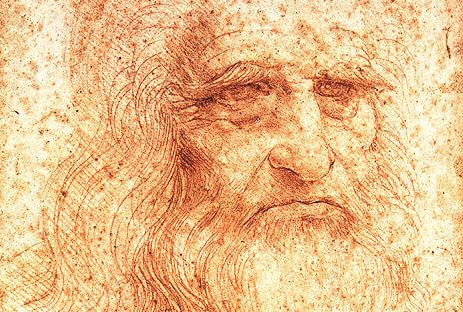
The subject is an elderly man depicted in three-quarter view, with a long, wavy beard, thick hair, prominent eyebrows and a face marked by deep wrinkles. His gaze is intense and focused, with some parts of his face rendered in great detail while others are only lightly sketched. The result is an image that seems to capture not only a person’s physical appearance but also his character and the depth of his thoughts.
The dating of the drawing is not universally agreed upon. According to the interpretation supported by the Royal Museums of Turin, the work may have been created around 1517, when Leonardo was approximately 65 years old and living in France at the court of Francis I. Other scholars have proposed an earlier date, which would make it more difficult to identify the subject as Leonardo himself.
Inside Leonardo’s World
Experience interactive machines and inventions at the Leonardo Da Vinci Exhibition in Rome
Does the self-portrait really depict Leonardo?
The main reason why the drawing’s identification as a self-portrait remains disputed is that there is no contemporary account from Leonardo’s lifetime that conclusively proves the man depicted is Leonardo himself. The title by which the work is commonly known reflects a traditional interpretation, but does not in itself provide evidence of the subject’s identity.
Another issue concerns the age of the man depicted. Leonardo was born in 1452 and died in 1519, at the age of 67, while the face in the drawing appears to belong to someone considerably older. This is not enough to rule out a self-portrait, as physical condition, individual features and the artist’s expressive choices can all influence a subject’s apparent age. However, there is also the question of when the drawing was created.
Art historian Pietro Marani has observed that certain stylistic features of the drawing, such as its fine, incisive hatching, resemble works created by Leonardo in the 1490s. If the drawing really dates from that period, Leonardo would have been around forty years old, making it difficult to interpret the elderly face as a self-portrait drawn from life.
Marani therefore suggested that the drawing might have been a study for the face of an apostle in The Last Supper. Leonardo was known for observing and drawing the faces of elderly people and men with distinctive features and pronounced expressions, using them as studies for his works. The Portrait of an Old Man could therefore be part of this artistic research.
What evidence suggests that the man depicted is Leonardo?
Despite these doubts, there are also arguments supporting the identification of the Portrait of an Old Man as a self-portrait. One of the main arguments concerns the resemblance between the subject and historical descriptions of Leonardo’s appearance. In the final years of his life, Leonardo had long hair and a long beard, giving him a particularly distinguished appearance.
The drawing has also been compared with other images traditionally associated with Leonardo, including the figure of Plato in Raphael’s School of Athens. According to a widely accepted interpretation, Raphael gave the Greek philosopher the features of the Florentine master, depicting him as an elderly man with a long beard.
Another argument concerns the quality of the drawing and its technical characteristics, which are considered consistent with Leonardo’s graphic work. The Royal Museums of Turin support the traditional interpretation and date the drawing to the final years of the artist’s life, when he may have depicted himself as an elderly man.
How the Portrait of an Old Man became the face of Leonardo da Vinci
Regardless of the identity of the man depicted, the Portrait of an Old Man has played a fundamental role in shaping the public image of Leonardo da Vinci. Today, the sight of an elderly man with long hair, a flowing beard and a thoughtful expression is enough to immediately bring to mind the features we associate with the great Renaissance artist. However, this familiarity is also the result of a long history of reproductions and interpretations.
The drawing was already known before it entered the Savoy collection in 1839, when it was purchased by King Charles Albert. In the early 19th century, copies and interpretations of the portrait were already circulating, including those associated with Giuseppe Bossi, an artist and scholar who contributed to the rediscovery and wider appreciation of Leonardo’s work.
Throughout the 19th century, reproductions of the drawing in engravings, publications and later photographs helped strengthen the association between the face and the artist. Reproductions produced during the second half of the century were particularly important, as interest in Leonardo and his achievements as a painter, inventor and scholar continued to grow.
The image also fitted perfectly with the Romantic ideal of the universal genius: an elderly man with a stern expression and a long beard, seemingly embodying the wisdom and knowledge accumulated over a lifetime devoted to observing nature and pursuing knowledge.
Through books, school textbooks, exhibitions and reproductions, the presumed self-portrait gradually became the most recognisable image of Leonardo, eventually turning into a symbol of his genius. The fact that the identification remains disputed does not diminish the drawing’s importance, but adds an intriguing element to its history: the image by which we all recognise Leonardo may not actually depict Leonardo himself.
Leonardo Live
Visit the Leonardo Da Vinci Exhibition in Rome and discover his machines, inventions, and much more first-hand
You can read the Italian version of this article here >