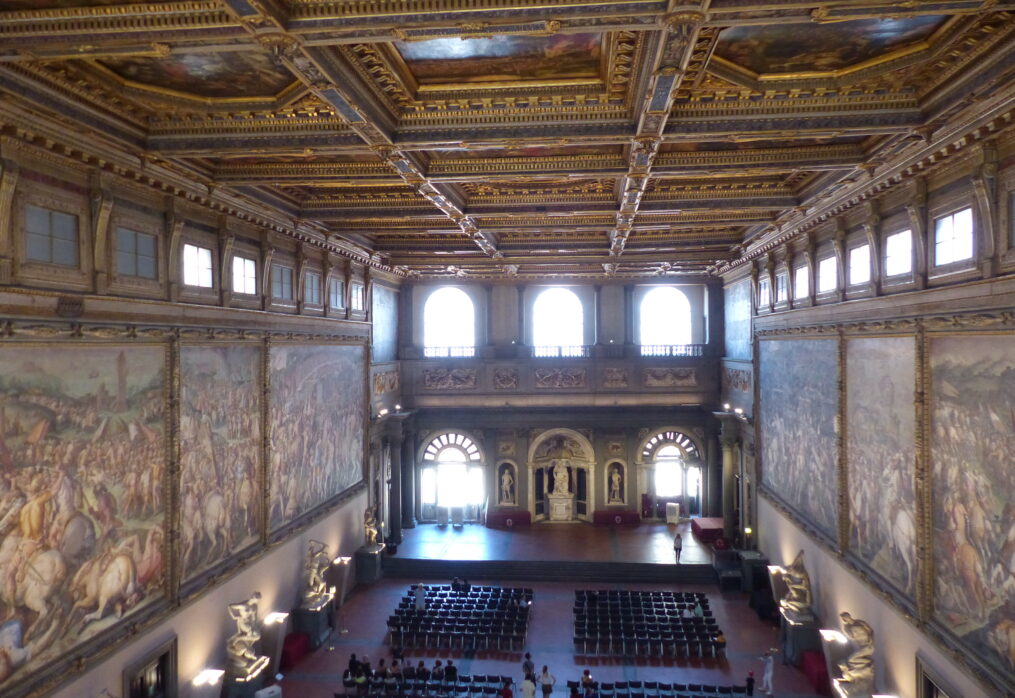

Leonardo da Vinci and Michelangelo Buonarroti were at the centre of one of the most famous artistic competitions of the Renaissance, culminating in the challenge of decorating Palazzo Vecchio in Florence.
Were Leonardo da Vinci and Michelangelo really rivals? The two great Renaissance artists probably had a relationship marked by tension and competition, but there is not enough evidence to suggest that they were genuinely enemies. Leonardo, born in 1452, was 23 years older than Michelangelo, and the two had very different approaches to art: the former devoted himself to painting, observing nature and experimentation, while the latter favoured sculpture and the study of the human body. The rivalry between Leonardo and Michelangelo became particularly evident in Florence, when both were commissioned to paint two large battle scenes in the Hall of the Great Council at Palazzo Vecchio. Leonardo worked on the Battle of Anghiari and Michelangelo on the Battle of Cascina, but neither completed his work. Accounts from the period also describe episodes of personal tension, although these may simply be anecdotes passed down over the centuries without any factual basis.
TABLE OF CONTENTS
- Were Leonardo and Michelangelo really rivals?
- Two Renaissance geniuses, two different approaches to art
- The Palazzo Vecchio challenge: the Battle of Anghiari and the Battle of Cascina
- When did the rivalry between Leonardo and Michelangelo end?
Were Leonardo and Michelangelo really rivals?
In the history of Renaissance art, the rivalry between Leonardo da Vinci and Michelangelo Buonarroti is well known, but the relationship between the two artists is more difficult to reconstruct than one might imagine. Leonardo and Michelangelo both lived and worked in Florence in the early 16th century and were involved in an extraordinary artistic competition, but accounts of their personal relationship are scarce and not always verifiable.
One of the most famous anecdotes is recorded in the so-called Anonimo Gaddiano, a 16th-century manuscript containing accounts of artists’ lives. According to this story, Leonardo was near Santa Trinita in Florence when some people asked him to explain a passage from Dante. Seeing Michelangelo approaching, Leonardo supposedly suggested that they ask him instead, but Michelangelo allegedly interpreted those words as a provocation and responded offensively.
The episode is often cited as evidence of the dislike between the two, but it is an account passed down by a source written after the events, rather than a firsthand testimony. It is therefore uncertain whether the encounter took place in this way or what the two artists’ real intentions were.
The artistic competition, on the other hand, is documented and reflects the cultural climate of Renaissance Florence, where the most established artists sought to secure prestigious commissions and demonstrate their abilities. Leonardo and Michelangelo were two leading figures, and their rivalry reached its most significant moment when they were commissioned to work on the same public building.
Inside Leonardo’s World
Experience interactive machines and inventions at the Leonardo Da Vinci Exhibition in Rome
Two Renaissance geniuses, two different approaches to art
Leonardo was born in Vinci in 1452, while Michelangelo was born in Caprese in 1475: they were therefore 23 years apart, belonged to two different generations and, above all, had very different artistic backgrounds.
By the time they found themselves working in the same city, Leonardo had already achieved great fame thanks to his work in Florence and Milan, where he had created works such as The Last Supper. His activities, however, extended beyond painting to include studies of anatomy, engineering, mechanics and natural phenomena. For Leonardo, observing reality and understanding how it worked was also essential to representing it through art.
Michelangelo, although much younger, had already demonstrated extraordinary talent in sculpture. After creating the Pietà in the Vatican, he worked on David between 1501 and 1504, a sculpture destined to become one of the symbols of the Florentine Republic. His training and approach to art were deeply rooted in sculpture, even when he turned to painting.
Both had an extensive knowledge of anatomy, and the differences between them emerged mainly in the way they represented the human body. Leonardo studied movement, expressions and the relationships between figures, also seeking to understand the emotions and natural phenomena that influenced the subjects he depicted, while Michelangelo focused more on anatomical structure, strength and the tension of the body, often portraying figures in complex and dynamic poses.
The Palazzo Vecchio challenge: the Battle of Anghiari and the Battle of Cascina
The most significant moment in the competition between Leonardo and Michelangelo came in the early 16th century, when the Florentine Republic decided to decorate the Hall of the Great Council in Palazzo Vecchio, now known as the Salone dei Cinquecento. The aim was to celebrate Florence’s history and military victories through large-scale wall paintings commissioned from artists of exceptional prestige.
In 1503, Leonardo was commissioned to depict the Battle of Anghiari, fought in 1440 between Florentine and Milanese forces. The following year, Michelangelo was commissioned to paint the Battle of Cascina, commemorating the Florentine victory over the Pisans in 1364. The two artists would therefore work in the same hall, creating works that anyone entering the room would inevitably compare.
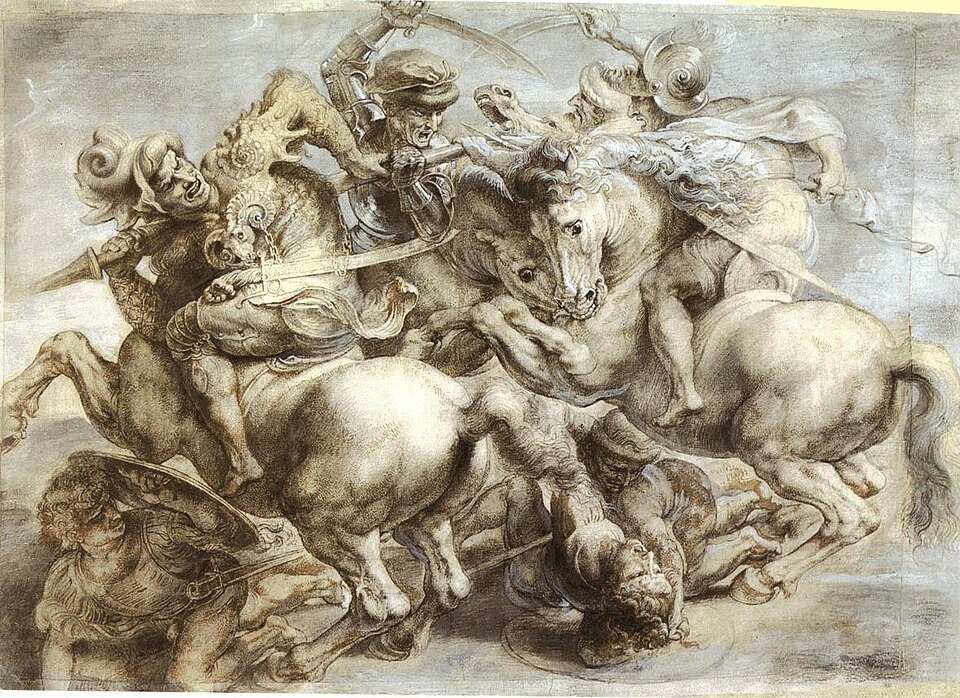
Leonardo devoted considerable time to preparatory drawings and planned a monumental composition depicting a violent struggle between horsemen for possession of a standard, with men and horses caught up in a fierce clash. He sought to convey the brutality of the battle through movement, facial expressions and the tension of the figures.
In 1505, he began painting on the wall but encountered serious technical difficulties because he chose to experiment with a method different from traditional fresco painting, which requires colours to be applied to plaster while it is still wet. The technique did not produce the desired results, and the paint failed to dry properly. As a result, work was interrupted and the Battle of Anghiari remained unfinished.
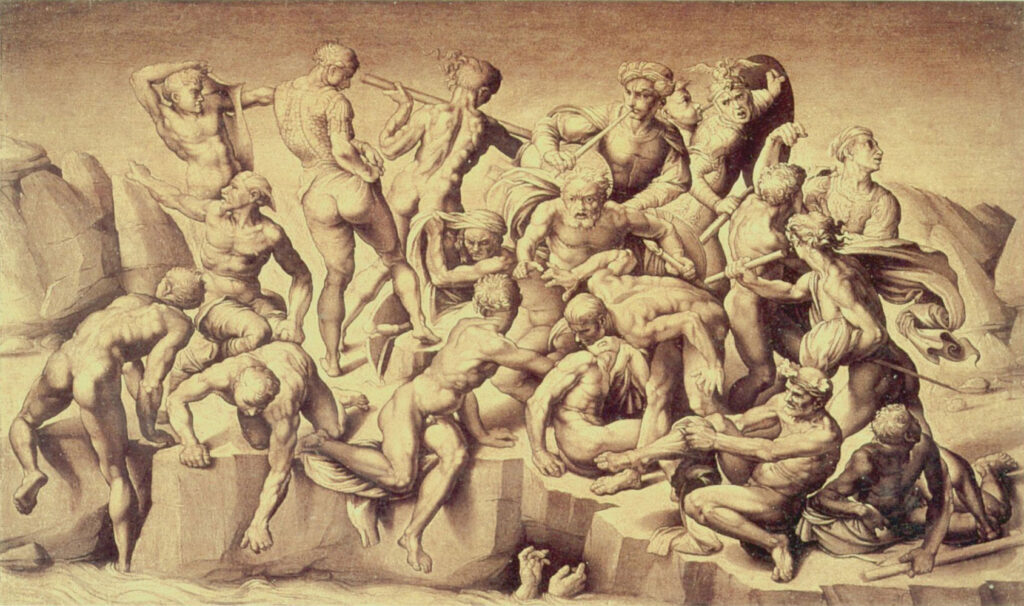
Michelangelo, on the other hand, approached the Battle of Cascina by focusing on a particular episode: a group of Florentine soldiers, alerted while bathing in the River Arno, rush out of the water and hurriedly get dressed to prepare for battle. This choice allowed him to depict numerous naked male bodies in motion, demonstrating his knowledge of anatomy and his ability to portray complex poses.
Michelangelo produced the preparatory cartoon, a full-scale drawing intended to guide the execution of the painting, but he never painted the scene on the wall because, in 1505, Pope Julius II summoned him to Rome to work on his monumental tomb, leading him to abandon the Florentine project.
The Palazzo Vecchio challenge therefore ended without either artist completing his work. Nevertheless, their projects attracted great admiration, were studied by other painters and contributed to the spread of new approaches to representing movement and the human body.
When did the rivalry between Leonardo and Michelangelo end?
After the competition at Palazzo Vecchio, their careers continued mainly in different cities and settings. Leonardo returned to work in Milan and, in the following years, also spent time in Rome, before moving to France, where he died in 1519. Michelangelo, meanwhile, continued to receive important commissions, particularly in Rome and Florence, creating works that would leave a profound mark on art history, including the frescoes on the ceiling of the Sistine Chapel.
The Florentine competition nevertheless remained one of the most significant episodes of their careers and, rather than a personal feud, the story of Leonardo and Michelangelo is above all about the encounter and comparison between two extraordinary approaches to Renaissance art.
Their rivalry became famous because, for a brief period, two of the greatest artists in history found themselves working in the same place, on commissions of equal prestige, leaving an artistic legacy that extended far beyond the unfinished works at Palazzo Vecchio.
Leonardo Live
Visit the Leonardo Da Vinci Exhibition in Rome and discover his machines, inventions, and much more first-hand
You can read the Italian version of this article here >