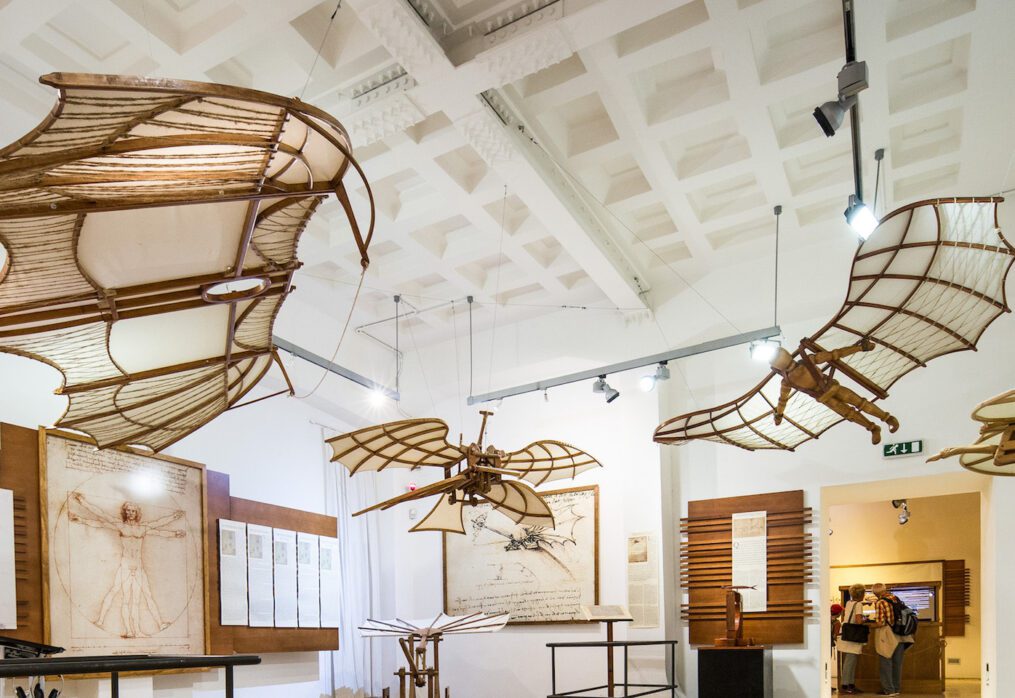

Leonardo da Vinci’s fascination with flight: observations of birds, flying machines, the Codex on the Flight of Birds and ideas that were centuries ahead of their time.
Leonardo was fascinated by flight throughout his life, studying the movements of birds and exploring the behaviour of air currents. When he realised that human muscle power alone was not enough to keep a person airborne, he turned his attention to more effective solutions, such as gliding on rising air currents inspired by birds of prey. He then carried out practical experiments with human-powered flying devices, and the machines he designed, including the ornithopter, the glider and the aerial screw, anticipated the development of aviation by several centuries.
TABLE OF CONTENTS
- Leonardo and the observation of nature
- The dream of flight
- Flight as a metaphor for knowledge
- Leonardo’s flying machines
- The Codex on the Flight of Birds
- Technical limitations and brilliant insights
Leonardo and the observation of nature
Every one of Leonardo’s ideas originated from direct observation of the natural world, and his studies of flight were no exception.
Before attempting to design flying machines, Leonardo spent countless hours in the countryside observing birds in flight, carefully studying the movement of their wings, changes in direction and their ability to take advantage of air currents. His goal was not simply to admire nature, but to translate what he saw into sketches, measurements and mechanical principles.
For Leonardo, nature was the greatest engineering manual ever written. Around 1505, in the Codex on the Flight of Birds, he carefully recorded the behaviour of flocks and analysed the differences between flapping flight and gliding. Understanding how birds flew meant discovering the universal laws that governed air and movement, making it possible to design machines capable of human flight.
Inside Leonardo’s World
Experience interactive machines and inventions at the Leonardo Da Vinci Exhibition in Rome
The dream of flight
The dream of flying has accompanied humanity since ancient times, from the myth of Daedalus and Icarus to medieval legends. Leonardo shared this dream, but unlike the mythical tradition, he approached it through observation and experimentation.
In one of his writings he refers to a “great bird that will take flight from the back of its great parent“, words that combine poetry and science while revealing how flight represented, for him, not only a technical challenge but also a symbol of freedom and knowledge. To rise into the sky meant seeing the world from above and discovering the hidden harmony that governed nature.
Flight as a metaphor for knowledge
The Renaissance was an age shaped by humanism, a period in which human beings were placed at the centre of intellectual life and encouraged to push beyond their own limits. Within this cultural context, flight represented far more than a dream: it became the symbol of humanity’s desire to reach new discoveries.
Leonardo combined technical research with a powerful symbolic vision. Throughout his notebooks he drew wings, aerial screws and gliding machines, presenting them not only as mechanical inventions but also as instruments of both physical and spiritual ascent.
In his writings, descriptions of mechanical devices are often intertwined with poetic images in which the sky becomes a place of freedom and higher vision. The desire to fly therefore becomes a universal metaphor that still speaks today of courage, curiosity and the ability to imagine what seems impossible.
Leonardo’s flying machines
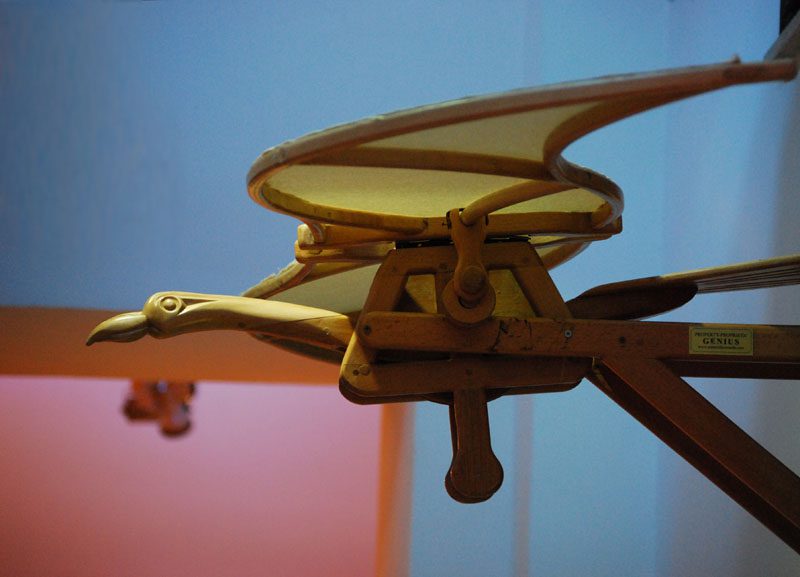
Leonardo was not satisfied with simply imagining human flight. He sought to transform his ideas into practical designs by drawing numerous flying devices, some of which remained simple sketches while others were developed in remarkable detail. The best known is the ornithopter, a machine equipped with large movable wings intended to be powered by the pilot’s arms and legs in imitation of the flapping flight of birds. It was an extraordinary concept, although it was ultimately limited by the impossibility of reproducing the strength and endurance of birds with human muscles alone.
Equally revolutionary was Leonardo’s design for a parachute, a pyramid-shaped canopy made of cloth stretched over a wooden frame. Leonardo wrote that with such a device “any man will be able to throw himself down from any great height without suffering injury”. More than five centuries later, in 2000, a Swiss parachutist successfully tested a parachute built according to Leonardo’s drawings, demonstrating that the design was fundamentally sound.
Another remarkable invention is the so-called aerial screw, a spiral-shaped canvas rotor that, if rotated rapidly enough, was intended to lift itself into the air. Often regarded as a precursor to the modern helicopter, it is one of many examples of Leonardo’s ability to anticipate aerodynamic principles that would only become technically feasible with the development of modern engineering.
His notebooks also contain sketches of gliders, soaring machines and instruments designed to measure air resistance. Although none of these devices ever truly took flight, they demonstrate Leonardo’s lifelong determination to understand how humans might one day conquer the skies.
The Codex on the Flight of Birds
Among Leonardo’s manuscripts, the Codex on the Flight of Birds is an extraordinary testimony to his working method. Across eighteen folios, the codex examines complex questions related to flight, including air resistance, stability in flight, the role of air currents and vortices, and describes practical experiments such as dropping feathers or pieces of paper to observe the movement of air.
The manuscript shows the transition from dream to scientific investigation, in which flight is no longer simply a matter of imagination but a phenomenon studied with rigour. Although it did not lead to immediate practical results, the codex anticipated the experimental method that would later become the foundation of modern science. For this reason, it is regarded as a milestone in the history of aeronautics and was even cited in some of the first nineteenth-century studies on gliding flight.
Technical limitations and brilliant insights
Despite the brilliance of Leonardo’s ideas, none of his machines ever succeeded in leaving the ground because the available materials were too heavy and human muscle power was insufficient.
These failures do not diminish the importance of his insights. On the contrary, they demonstrate just how far ahead of his time Leonardo was. Many of his ideas contained principles that would be rediscovered and developed in the centuries that followed.
As mentioned earlier, Leonardo’s parachute has proved capable of working, the aerial screw anticipated the principles behind the helicopter, and the ornithopter illustrates the tension between imitating nature and developing independent mechanical solutions.
Leonardo understood that flight required not only wings but also balance, control and lightweight materials, concepts that would become reality only with the invention of engines and lightweight alloys.
Leonardo Live
Visit the Leonardo Da Vinci Exhibition in Rome and discover his machines, inventions, and much more first-hand
This article was originally published in Italian on 15 September 2025
You can read the Italian version of this article here >