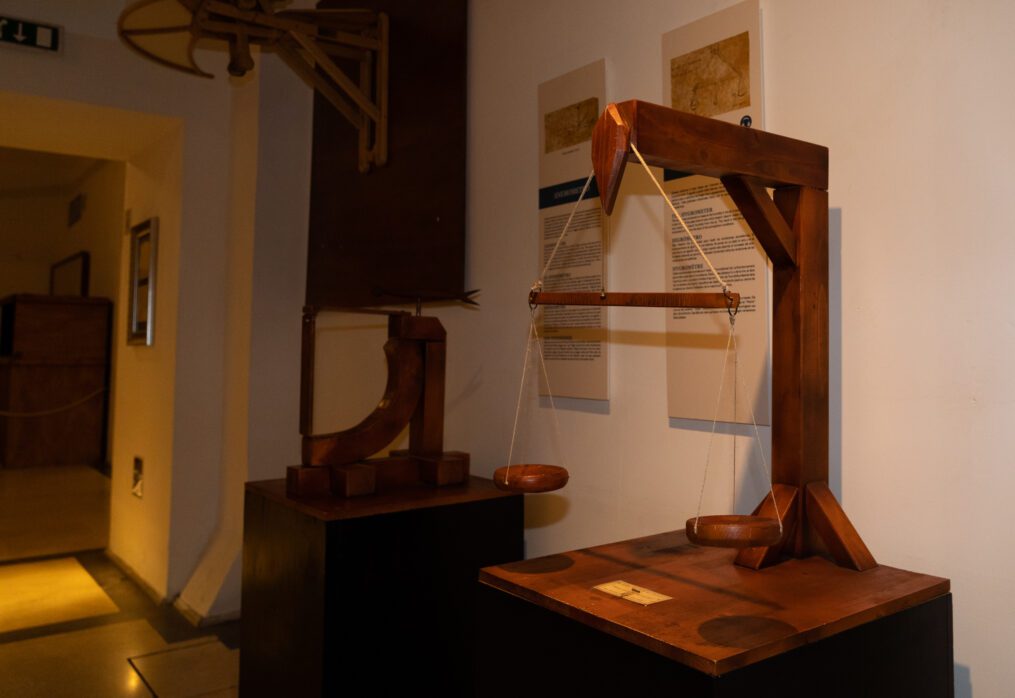

Leonardo da Vinci’s mechanical inventions, from simple machines to the aerial screw, from self-supporting bridges to automata and military machines.
Leonardo da Vinci’s mechanical inventions are among the most fascinating aspects of the Renaissance genius, combining art, science and practical ingenuity. In his studies, Leonardo analysed and refined simple machines such as levers, pulleys, screws and winches, considering them the foundation for understanding the laws of motion and transforming them into more complex devices. These investigations gave rise to extraordinary designs, including the aerial screw, which anticipated the modern helicopter, gear-driven automata, portable self-supporting bridges, military machines and hydraulic devices for lifting water. Although many of these projects were never built, the drawings preserved in the Codex Atlanticus and the Madrid Codices testify to a visionary approach that anticipated many principles of modern engineering. For Leonardo, mechanics was not merely a technical discipline but a true art, another language through which he could observe nature, reduce human effort and translate the mechanisms governing the world into practical reality.
TABLE OF CONTENTS
- What simple machines did Leonardo study?
- What was Leonardo’s aerial screw?
- Bridges and mechanical structures designed by Leonardo
- Did Leonardo really invent automata and moving machines?
- What were Leonardo’s war machines like?
- The legacy of Leonardo’s mechanical inventions
What simple machines did Leonardo study?
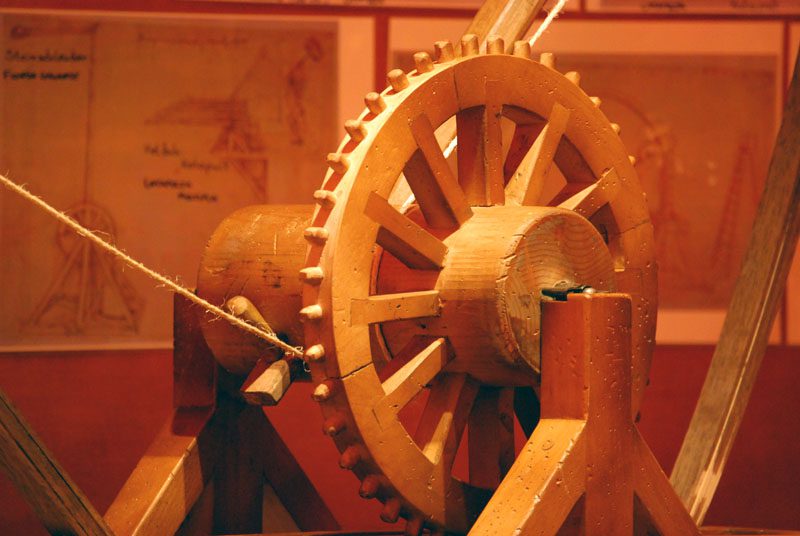
For Leonardo da Vinci, mechanics was the “daughter of geometry”. In his notebooks, he described simple machines as the fundamental building blocks of mechanics, including levers, pulleys, inclined planes, winches and worm screws.
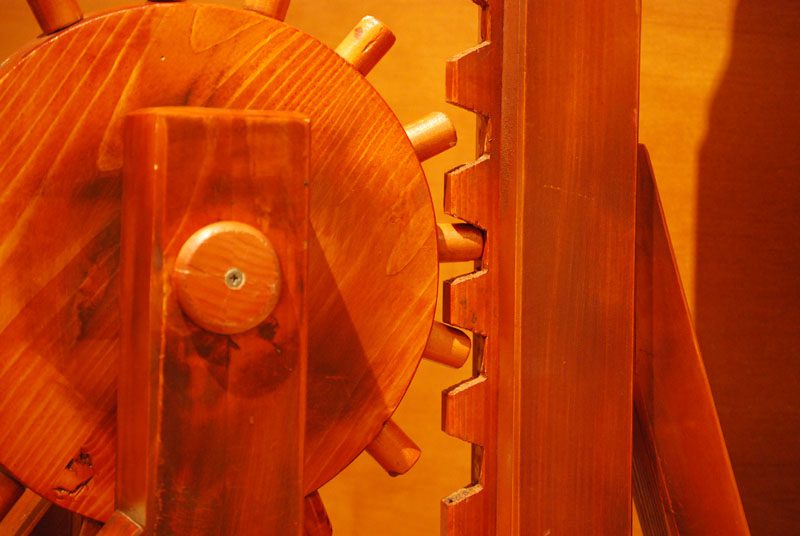
He observed these devices, drew them and analysed how they worked in order to understand the physical principles behind them. He realised that by combining simple machines it was possible to create far more complex mechanisms capable of multiplying force and, consequently, reducing human effort.
These observations became the foundation of all his later inventions, from military machines to hydraulic devices, anticipating the principles of modern mechanical engineering by several centuries.
Inside Leonardo’s World
Experience interactive machines and inventions at the Leonardo Da Vinci Exhibition in Rome
What was Leonardo’s aerial screw?
One of Leonardo’s most famous inventions is the aerial screw, designed around 1485. It consisted of a large helical structure made of wood and linen, intended to rise into the air by spinning rapidly around its vertical axis.
Although it could not have been built using the materials and technology available at the time, the design is widely regarded as a precursor to the modern helicopter. It also demonstrates how Leonardo approached mechanics by drawing inspiration from nature, studying the flight of birds and attempting to translate those observations into mechanical devices.
This experimental approach, based on detailed drawings and theoretical reflections, illustrates how Leonardo’s inventions were scientific visions that lay centuries ahead of their time.
Bridges and mechanical structures designed by Leonardo
Leonardo also devoted considerable attention to mechanical structures intended for architecture and logistics. In his notebooks, he described movable, revolving and self-supporting bridges designed to be assembled and dismantled quickly.
Some of these structures were conceived for military purposes, allowing armies to cross rivers and other obstacles with greater speed, while others were intended for civilian use, serving to connect riverbanks and canals.
Particularly ingenious was Leonardo’s self-supporting bridge, based on interlocking beams that supported one another without the need for nails or ropes. The design demonstrates Leonardo’s remarkable ability to translate the principles of geometry into practical engineering solutions, and it is still reproduced today as an educational engineering exercise.
Did Leonardo really invent automata and moving machines?
One of Leonardo’s most remarkable projects involved mechanical automata. He designed a mechanical knight capable of moving its arms and head through a system of gears and pulleys, as well as an automatic lion that could walk on its own. According to historical accounts, the lion was presented to King Francis I of France as a spectacular diplomatic gift.
These inventions reflect Leonardo’s fascination with automated machines and show that, for him, mechanics was not only useful for warfare or manual work but also for entertainment, theatrical productions and demonstrating the extraordinary potential of human ingenuity.
What were Leonardo’s war machines like?
Although Leonardo had a fundamentally pacifist outlook, he nevertheless devoted considerable attention to the design of military machines commissioned by the powerful rulers of his time.
Among Leonardo’s war machines were self-propelled armoured vehicles, catapults, giant crossbows and mobile siege towers. In many cases, these designs were impossible to build with the technology available at the time, yet they reveal a profound understanding of applied mechanics.
Some scholars believe that Leonardo deliberately introduced technical flaws into certain drawings to prevent the machines from ever being built. If this interpretation is correct, it would reflect the inner conflict between his desire to satisfy influential patrons and his personal opposition to the violence of war.
The legacy of Leonardo’s mechanical inventions
The Codex Atlanticus and the Madrid Codices preserve hundreds of sketches that demonstrate Leonardo’s extraordinary ability to combine observation of the natural world, mathematical calculation and imagination.
Although many of his inventions were never built, Leonardo’s legacy in the field of mechanics is immense. The principles he developed, from the study of flight to self-supporting structures, influenced centuries of engineering and technological innovation.
Today, Leonardo’s mechanical inventions are studied not only as historical documents but also as outstanding examples of the scientific method. They encourage us to observe nature, translate it into geometric principles and transform those observations into practical solutions capable of improving human life.
Leonardo Live
Visit the Leonardo Da Vinci Exhibition in Rome and discover his machines, inventions, and much more first-hand
This article was originally published in Italian on 25 September 2025
You can read the Italian version of this article here >