
A journey through Rome’s hidden underground sites, including basilicas, ancient Roman houses, catacombs, aqueducts and archaeological remains.
What lies beneath the streets, squares and buildings of Rome? The city we see today developed over the centuries on top of the ancient one, incorporating temples, homes, places of worship, necropolises and infrastructure that, in some cases, now lie several metres below the present street level. There are many reasons for this complex stratification. Abandoned or destroyed buildings were reused as foundations for new constructions, while floods, fires, debris and urban transformations gradually altered the ground level. Exploring Rome’s underground sites therefore means travelling through different historical periods and observing the city’s past from a highly unusual perspective. Beneath one basilica there may be an even older church, behind the Trevi Fountain the rooms of an ancient Roman house are still preserved, and underground the water of an aqueduct built more than two thousand years ago continues to flow. Here are five fascinating facts about underground Rome and the places where they can be discovered.
TABLE OF CONTENTS
- A basilica beneath another basilica
- The ancient Roman house beneath the Trevi Fountain
- The Tomb of Aulus Hirtius
- Rome’s underground catacombs
- The Roman aqueducts beneath the city
A Basilica Beneath Another Basilica
Just a short walk from the Colosseum stands the Basilica of San Clemente, whose visit offers a remarkable journey through centuries of history within just a few metres. Descending through its different levels, visitors travel from Imperial Rome to the spread of Christianity and finally to the medieval city.
The present-day basilica dates back to the Middle Ages, but beneath it lies an older church built in the 4th century and used until the end of the 11th century. As visitors enter the archaeological complex, they move from the current church to the Early Christian basilica, where columns, architectural features and medieval frescoes dating from the 8th to the 11th century can still be admired.
The journey does not end there. Descending even further reveals an even older level made up of Roman buildings, including a residential structure and another building that was later converted into a mithraeum, a sanctuary dedicated to the cult of Mithras. This mystery religion, widespread throughout the Roman Empire between the 1st and 4th centuries AD, involved initiation rites reserved for its followers and was often practised in underground or dimly lit spaces.
San Clemente is a perfect example of Rome’s archaeological stratification, where each layer was built by reusing part of the structures beneath it, adapting them to new purposes over time. In this case, the Roman buildings became the foundations of the Early Christian basilica, which in turn was buried beneath the medieval church that still stands today.
In Rome with Leonardo
Add the Leonardo Exhibition to your things to do in Rome
The ancient roman house beneath the Trevi Fountain
Every day, thousands of visitors gather at the Trevi Fountain to admire one of Rome’s most famous landmarks, and many take part in the traditional ritual of tossing one or more coins into its waters, a gesture said to guarantee a return to the Eternal City or even the beginning of a new romance. Few people realise, however, that beneath the surrounding buildings lies an archaeological site known as Vicus Caprarius, or the City of Water. Discovered during the renovation of the former Cinema Trevi, the site preserves the remains of an ancient neighbourhood that once formed part of the Campus Martius.
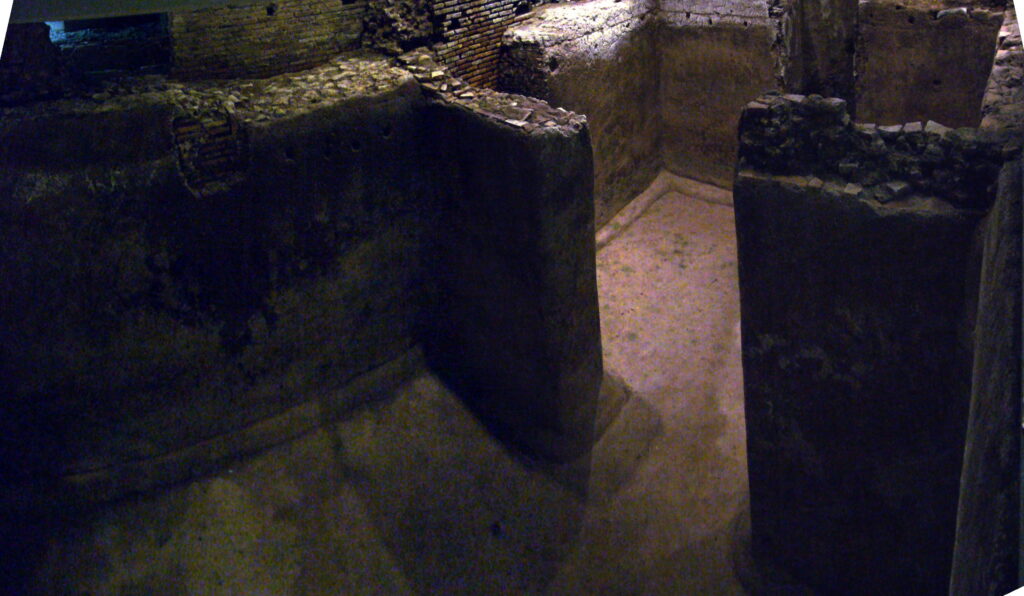
Several metres below the present street level are the remains of a large Roman house dating back to the Imperial period. Its rooms were altered several times over the centuries, reflecting both the changing appearance of the city and the evolving needs of its inhabitants. The archaeological route includes walls, floors and numerous artefacts uncovered during the excavations, such as coins, decorative elements, marble fragments and everyday objects, all of which offer a vivid insight into daily life in ancient Rome.
The site’s close connection with water is explained by the presence of a castellum aquae, a large cistern used to collect and distribute water supplied by the Aqua Virgo aqueduct. Water has played a fundamental role in the history and development of this part of Rome and is still present within the archaeological area today, contributing to the unique atmosphere of these fascinating underground spaces.
The Tomb of Aulus Hirtius
Hidden beneath Palazzo della Cancelleria lies an archaeological site that remains largely unknown, even to visitors who have explored Rome’s historic centre many times: the Tomb of Aulus Hirtius. A Roman consul and close associate of Julius Caesar, Hirtius played an important role in the political and military events of the final years of the Roman Republic.
After Caesar’s assassination, he fought against Mark Antony and was killed in 43 BC during the Battle of Mutina, alongside his fellow consul Gaius Vibius Pansa. The Senate honoured both consuls with public funerals and monumental tombs in the Campus Martius.
The tomb attributed to Aulus Hirtius was discovered in 1938 during excavation work beneath Palazzo della Cancelleria. Its location clearly illustrates how dramatically Rome’s ground level has changed over the centuries: what was once an open-air monument along one of the ancient roads of the Campus Martius is now enclosed within the underground levels of a Renaissance palace.
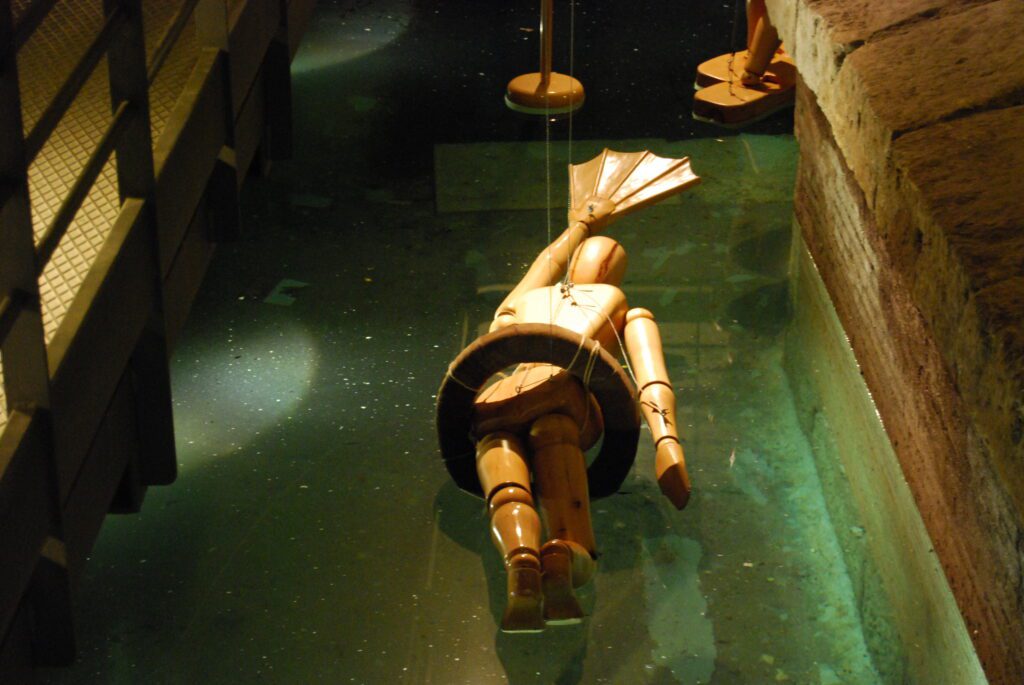
The presence of water makes the site even more fascinating. Much of the monument is submerged beneath the waters of the ancient Euripus, a canal that crossed the Campus Martius and formed part of the area’s water system before flowing into the Tiber. As a result, only part of the structure can be seen today, creating a unique underground landscape in the heart of Rome.
The tomb can be visited at the end of the Leonardo da Vinci Exhibition, housed inside Palazzo della Cancelleria, just a short walk from Campo de’ Fiori and Piazza Navona. The exhibition therefore combines two seemingly distant experiences: on one hand, visitors can explore working models, studies and inventions recreated from Leonardo’s manuscripts, while on the other they can discover a funerary monument dating back to the final years of the Roman Republic.
Rome’s underground catacombs
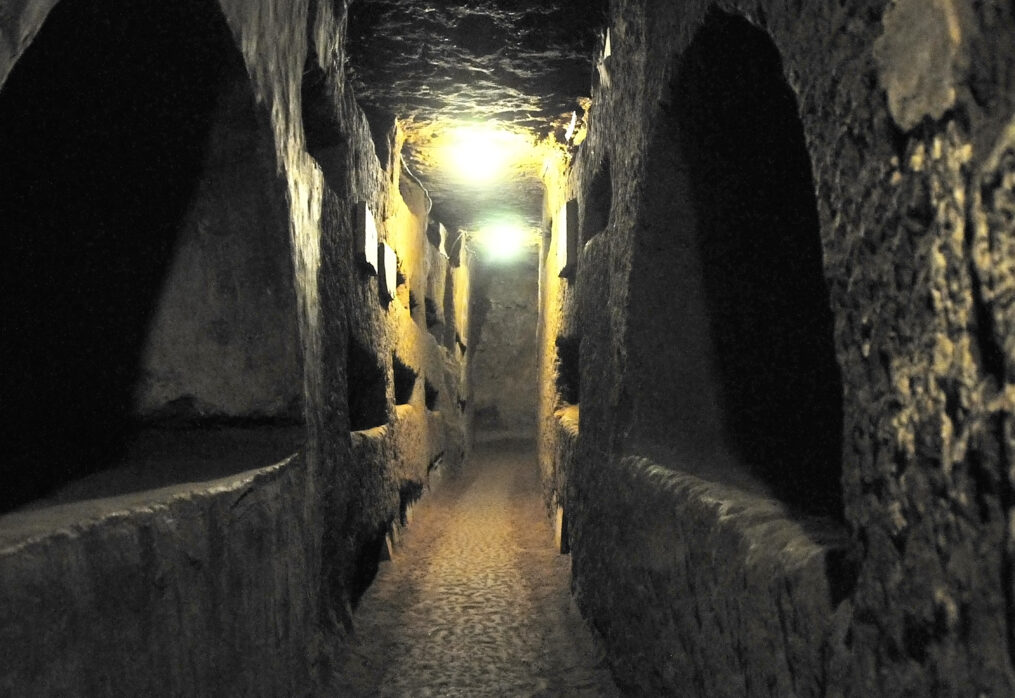
Rome’s catacombs are often imagined as secret passageways where the first Christians hid from persecution. In reality, rather than mysterious labyrinths, they are vast underground archives of the early Christian community, where inscriptions, burials and artworks reveal ancient beliefs about death, remembrance and the hope of resurrection.
The catacombs were originally created as burial sites and consist of underground funerary complexes formed by galleries carved mainly into tuff rock. Along their walls, niches known as loculi were excavated to accommodate the deceased. Since Roman law prohibited burials within the city walls, these cemeteries developed along the major consular roads leading out of Rome.
Some tombs belonged to individual families or communities, while burial chambers and crypts were often decorated with frescoes, inscriptions and symbolic imagery. Depictions of the Good Shepherd, the fish, the anchor and scenes from the Scriptures provide valuable insight into the earliest forms of Christian art. In the Catacombs of Priscilla, for example, visitors can admire one of the oldest known images of the Virgin Mary with the Child, dating to the first half of the 3rd century.
Among the best-known complexes are the Catacombs of Saint Callixtus, established from the 2nd century AD along the Appian Way and considered among the most important in Rome. Many martyrs and several popes were buried here, and one section is known as the Crypt of the Popes. The Catacombs of Domitilla are notable for their extensive network of galleries and for the underground basilica dedicated to Saints Nereus and Achilleus, while the Catacombs of Priscilla preserve exceptionally important paintings from the early Christian period.
Not all of Rome’s catacombs are open to visitors, and access to those that can be visited generally follows designated routes accompanied by a guide.
The roman aqueducts beneath the city
Much of ancient Rome’s water supply system ran underground in order to protect the water from contamination, reduce evaporation and maintain the gentle gradient needed for it to flow naturally. Above ground, arcades were built where necessary to cross valleys or keep the channels at the correct height as they approached the city. Many of these impressive structures are still visible today.
One of the most remarkable examples is the Aqua Virgo, commissioned in 19 BC by Marcus Vipsanius Agrippa, son-in-law and trusted adviser of Emperor Augustus. The aqueduct was built to supply water to Agrippa’s Baths in the Campus Martius and followed an underground channel for most of its route. It entered the city near the Muro Torto and continued towards the historic centre, where several ancient sections can still be seen today, including the stretch preserved in Via del Nazareno. Although the system has been restored and modified several times over the centuries, its route still preserves an extraordinary continuity with the original Roman infrastructure.
Perhaps the most remarkable fact is that the Aqua Virgo still supplies water to some of Rome’s most famous fountains today. The Trevi Fountain serves as the monumental terminal display of the aqueduct, while the same water also feeds several other fountains throughout the historic centre.
The Aqua Virgo also connects several of Rome’s underground sites. Its waters can be seen in the castellum aquae of Vicus Caprarius, flow behind the famous Trevi Fountain and continue to run through hidden channels beneath the city’s streets.
A Unique Idea for Your Visit
For a different kind of experience in Rome, explore the interactive Leonardo da Vinci Exhibition
You can read the Italian version of this article here >