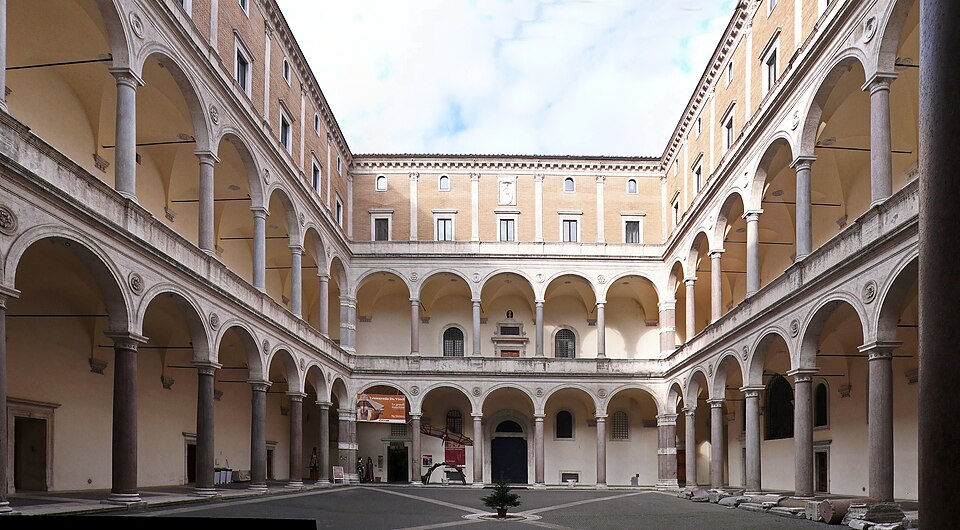

Palazzo della Cancelleria is one of Rome’s most important Renaissance buildings, featuring a courtyard attributed to Bramante, frescoes by Vasari and archaeological remains from ancient Rome.
Palazzo della Cancelleria in Rome is located in the square of the same name, just a short walk from Campo de’ Fiori, and is one of the city’s finest examples of Renaissance architecture. Built between the late 15th and early 16th centuries for Cardinal Raffaele Riario, it is particularly renowned for its travertine façade, the courtyard attributed to Bramante and rooms decorated by artists such as Giorgio Vasari. The complex also houses the Basilica of San Lorenzo in Damaso, while its underground areas contain the ancient Roman tomb of Aulus Hirtius, dating back to the 1st century BC, which can be visited through the Leonardo da Vinci Exhibition on the ground floor. The palace belongs to the Holy See, enjoys extraterritorial status and not all its rooms are always open to the public. Its exterior architecture can be admired at any time, but visitors wishing to explore the interior should check access arrangements in advance.
TABLE OF CONTENTS
- Palazzo della Cancelleria: the history of one of Rome’s great Renaissance palaces
- The architecture of Palazzo della Cancelleria and Bramante’s courtyard
- What to see inside Palazzo della Cancelleria: frescoes, underground areas and exhibitions
- How to visit Palazzo della Cancelleria in Rome
Palazzo della Cancelleria: the history of one of Rome’s great Renaissance palaces
Palazzo della Cancelleria is located in Rome’s historic centre, between Campo de’ Fiori and Corso Vittorio Emanuele II. As well as being considered one of the first great Renaissance palaces built in Rome, it has the distinctive status of belonging to the Holy See and therefore enjoying the extraterritorial privileges established by the Lateran Treaties of 1929, despite being located on Italian territory.
Construction began around 1485 at the initiative of Cardinal Raffaele Riario, nephew of Pope Sixtus IV, who wanted a prestigious residence that would reflect his family’s wealth and power.
However, Raffaele Riario was unable to retain his residence for long. In 1517, he was implicated in an alleged conspiracy against Pope Leo X, and the palace was confiscated, becoming the headquarters of the Apostolic Chancery, the papal institution from which it takes the name by which it is still known today.
Construction continued for several decades, including during the pontificate of Julius II, and involved the use of materials taken from monuments of ancient Rome, including the Colosseum and the nearby Theatre of Pompey. The work was completed in the early 16th century. The result was a monumental palace inspired by the buildings of classical antiquity, incorporating the ancient church of San Lorenzo in Damaso, which was rebuilt within the complex.
Over the following centuries, the building became home to offices and institutions of the Holy See, serving religious and administrative functions. It still houses ecclesiastical judicial bodies today, including the Tribunal of the Roman Rota.
In Rome with Leonardo
Add the Leonardo Exhibition to your things to do in Rome
The architecture of Palazzo della Cancelleria and Bramante’s courtyard
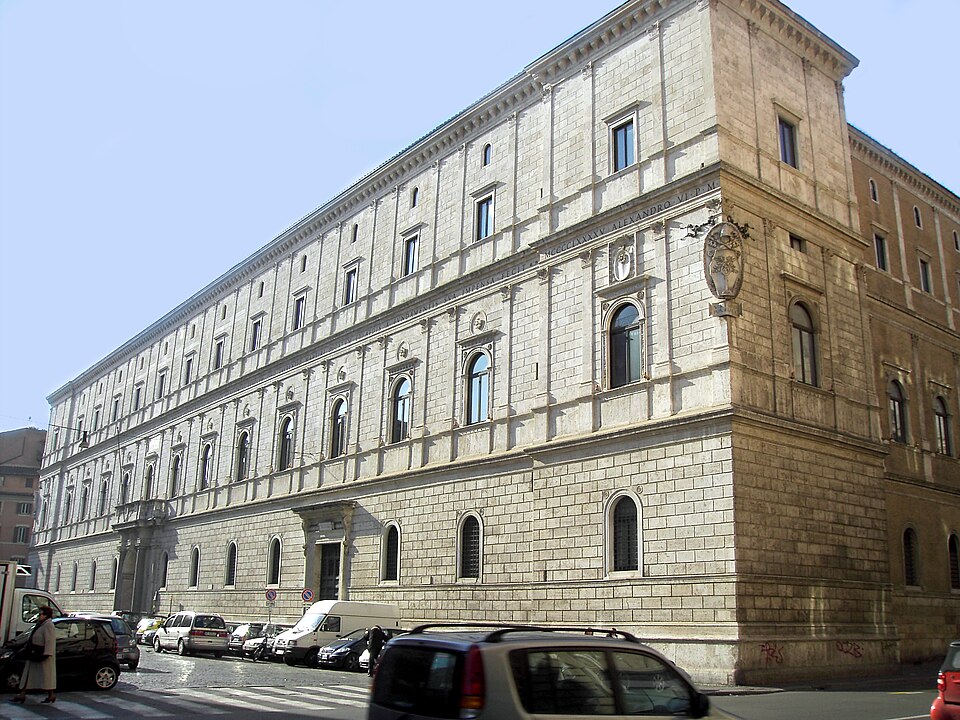
The Renaissance architecture of Rome is immediately evident in the main façade of Palazzo della Cancelleria, characterised by its extensive travertine cladding, regularly arranged windows and balanced proportions.
Unlike medieval palaces, often characterised by irregular structures and a fortified appearance, Palazzo della Cancelleria has an orderly façade, with architectural elements arranged according to a unified design. The main entrance is positioned off-centre, contributing to the building’s distinctive layout.
Inside the palace is Bramante’s courtyard, a rectangular space reached through the grand monumental entrance. It features arcades arranged over three levels, with columns, pillars and arches creating a harmonious composition inspired by classical architecture.
The courtyard is traditionally attributed to Donato Bramante, one of the leading architects of the Renaissance, who also worked on the design of the Tempietto of San Pietro in Montorio and the new St Peter’s Basilica. Scholars generally agree on his involvement in designing the courtyard, while attributing the entire Palazzo della Cancelleria to Bramante is more complicated, as construction took place in several phases and probably involved several architects.
Another distinctive feature of the complex is the Basilica of San Lorenzo in Damaso, whose history dates back to the 4th century. The ancient church was rebuilt during the Renaissance construction works and incorporated into the palace, so it does not have an easily recognisable independent façade from the outside.
The presence of the basilica, together with the courtyard and grand reception rooms, makes Palazzo della Cancelleria a particularly interesting example of how Renaissance architecture brought residential, religious and institutional functions together within a single building.
What to see inside Palazzo della Cancelleria: frescoes, underground areas and exhibitions
Beyond its façade and courtyard, Palazzo della Cancelleria preserves important historic rooms decorated over the centuries by some of the leading artists working in Rome.
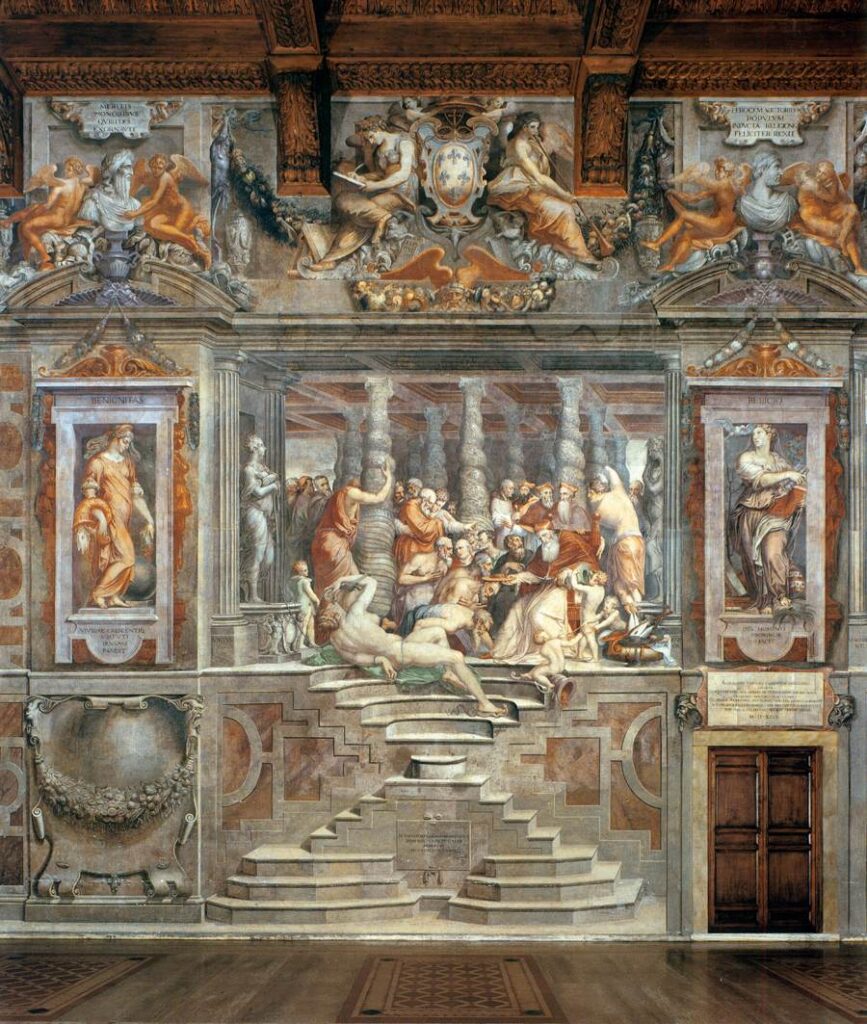
Among the best-known rooms is the Salone dei Cento Giorni (Hall of the Hundred Days), whose name refers to the speed with which its decoration was completed, reportedly in just one hundred days. The hall was decorated in 1546 by Giorgio Vasari and his assistants, with frescoes commissioned by Cardinal Alessandro Farnese depicting episodes and allegories associated with the pontificate of Pope Paul III Farnese.
The palace also contains the grand Sala Riaria, historically used for receptions and official functions, as well as other decorated spaces, including the Cappella del Pallio, featuring works by Francesco Salviati, and the Salone di Studio, whose ceiling has frescoes attributed to Perin del Vaga.
However, many of these rooms are used for institutional activities and are not normally accessible to visitors except on special occasions or through organised tours.
Another particularly interesting part of the visit concerns the underground areas of Palazzo della Cancelleria, where archaeological remains dating back to ancient Rome have been preserved. Among these is the tomb of Aulus Hirtius, discovered in 1938 and now largely submerged in water.
Aulus Hirtius was a general and associate of Julius Caesar who became consul in 43 BC and died that same year during the war against Mark Antony. Following his death, the Roman Senate ordered the construction of a public funerary monument in his honour. Several inscribed stone markers discovered in the area bear his name, allowing the tomb to be linked to this historical figure.
The presence of water is connected to the Euripus, an ancient canal that crossed the Campus Martius and helped drain water towards the River Tiber. Urban changes in the area, particularly the construction of the embankment walls along the river in the late 19th century, altered the drainage system, encouraging water to accumulate in the underground levels.
The tomb is part of the visitor route associated with the Leonardo da Vinci Exhibition, a permanent exhibition housed in rooms on the palace’s ground floor. The exhibition features working reconstructions of Leonardo’s machines and inventions, created from drawings in his notebooks, offering visitors the opportunity to explore different aspects of his scientific and technological work.
How to visit Palazzo della Cancelleria in Rome
Palazzo della Cancelleria is located at Piazza della Cancelleria 1, in Rome’s historic centre, just a few minutes’ walk from Campo de’ Fiori and not far from Piazza Navona, making it a convenient stop on itineraries exploring Rome’s Renaissance palaces and monuments.
The monumental façade can be admired freely from the square, where visitors can appreciate its travertine cladding, arrangement of windows and decorative elements. Access to the interior, however, is more restricted, as Palazzo della Cancelleria is not a museum that is entirely open to the public. Many rooms on the piano nobile, or main floor, are still used for institutional activities and can only be visited on special occasions or through organised initiatives. Anyone wishing to see the Salone dei Cento Giorni and other historic rooms should therefore check in advance whether guided tours or special openings are available.
The Basilica of San Lorenzo in Damaso, on the other hand, has its own entrance and can be visited according to its opening hours and religious services.
The Leonardo da Vinci Exhibition has a dedicated entrance and is open to ticket holders. Its visitor route also includes access to the tomb of Aulus Hirtius in the underground areas, offering the opportunity to discover both Leonardo’s inventions and part of the building’s archaeological history.
A Unique Idea for Your Visit
For a different kind of experience in Rome, explore the interactive Leonardo da Vinci Exhibition.
You can read the Italian version of this article here >