

Where is Leonardo’s famous wisteria, when does it bloom, and why is its connection with Leonardo da Vinci still a matter of debate?
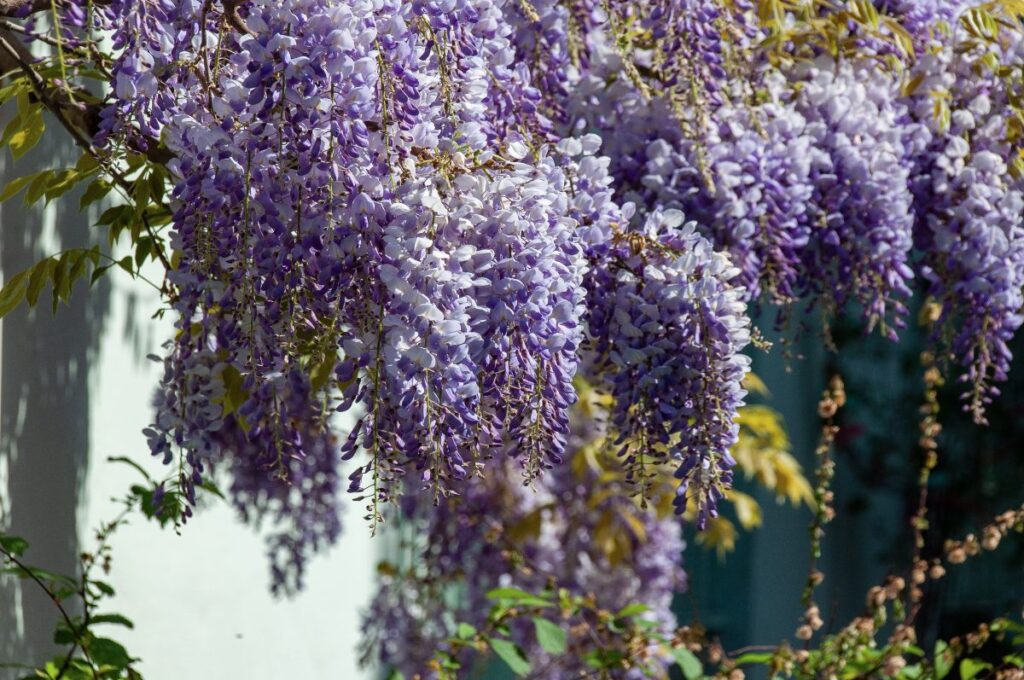
Leonardo’s wisteria is located in Milan, on Via Bernardino Verro, in the ancient district of Morivione, now part of the Ripamonti area. This large climbing plant became famous thanks to the legend that Leonardo da Vinci used to rest and meditate beneath its branches during his stay in Milan. The best time to admire it is in spring, especially between April and May, when it is covered with fragrant purple flower clusters. However, its connection with Leonardo has never been proven: the Asian wisteria species commonly found in European gardens today were introduced to the continent centuries after the artist’s death. The story should therefore be regarded as a fascinating local tradition rather than a historical fact. Nevertheless, a visit to the wisteria can be the starting point for discovering Leonardo-related sites in Milan, from the Last Supper to Castello Sforzesco, and for exploring the master’s inventions through the Leonardo da Vinci Exhibition in Rome.
Table of contents
- Where is Leonardo’s wisteria?
- When to see the wisteria in bloom
- Is it really Leonardo’s wisteria?
- Leonardo’s must-see sites
Where is Leonardo’s wisteria?
The so-called Leonardo’s wisteria is located in the southern part of Milan, at 2 Via Bernardino Verro, in the Scalo Romano district, within the Ripamonti area. Today this neighbourhood is fully integrated into the urban fabric of the city, but in the past it lay in open countryside, beyond the city walls, in an area characterised by irrigation canals, springs and waterways.
The plant grows inside a courtyard and climbs along the façade of a building, creating a spectacular cascade of purple flower clusters during the blooming season. The wisteria is therefore located on private property, although it can be admired without disturbing the residents.
The official tourism website of the Lombardy Region still lists it among Milan’s most interesting attractions, describing it as one of the oldest wisteria specimens in Italy.
There are many claims about its age that are extremely difficult to verify, including reports that the plant is more than seven hundred years old and has roots extending for kilometres. These stories are part of the legend that has grown around the wisteria over time, but they should be treated with caution, especially since they conflict with the documented history of the plant’s introduction to Europe.
Inside Leonardo’s World
Experience interactive machines and inventions at the Leonardo Da Vinci Exhibition in Rome
When to see the wisteria in bloom
The best time to see Leonardo’s wisteria in bloom is generally between April and May, although the exact timing may vary from year to year depending on weather conditions and seasonal temperatures. Wisteria is a climbing plant that produces flowers arranged in long, fragrant clusters, usually in shades of lilac and purple. It normally blooms in spring, although some specimens may produce a lighter second flowering during the summer months.
Before travelling to Via Bernardino Verro to enjoy the fragrance of the flowers and photograph the plant, it is worth checking recent updates or photographs, as the most spectacular stage of the flowering period may last only a few weeks.
A visit to the wisteria can easily be included in a broader itinerary through the southern part of Milan, continuing towards the Naviglio Pavese and the Conca Fallata, a hydraulic structure built after Leonardo’s death but often associated with his studies of water engineering. During his years in Milan, Leonardo studied canals, locks and systems for regulating water levels, contributing to the development of the city’s navigable canal network.
To continue exploring Leonardo’s legacy, visitors can then head to the centre of Milan, where they will find Santa Maria delle Grazie and Leonardo’s Last Supper. Another essential stop is Castello Sforzesco, where Leonardo worked in the service of Ludovico Sforza and created the decoration of the Sala delle Asse. Since these attractions are located some distance from Morivione, it is advisable to use public transport rather than attempting to walk the entire route.

Is it really Leonardo’s wisteria?
According to legend, Leonardo da Vinci visited the countryside of Morivione to study the local waterways and enjoyed resting in the shade of the great wisteria. Some versions of the story even claim that he used to meditate beneath its branches with Ludovico Sforza or that he found inspiration there for his hydraulic engineering projects. The story is undoubtedly fascinating and perfectly matches Leonardo’s image as a tireless observer of nature, but it is highly unlikely that he actually saw this wisteria during his stay in Milan.
The main reason for doubt is botanical: Leonardo lived between 1452 and 1519, while the ornamental wisteria species most commonly found in European gardens today originated in East Asia and only began spreading across Europe several centuries later. Wisteria sinensis, which is native to China, could therefore not have been growing in a Milanese courtyard during Leonardo’s lifetime. Consequently, the age traditionally attributed to the plant may not reflect its actual age.
It is possible that the story originated from the presence of another plant that once grew in the area and was later replaced or confused with the current wisteria, or that the association with Leonardo simply developed because of the site’s proximity to places connected with his studies of Milan’s waterways.
Without documentary evidence, it is impossible to know whether the Renaissance genius really rested and meditated while enjoying the intoxicating fragrance of this plant’s flowers. Nevertheless, the story once again demonstrates how Leonardo’s legacy continues to inspire tales, legends and curiosities more than five centuries after his death. Visiting the wisteria therefore offers an opportunity not only to discover an unusual corner of Milan, but also to reflect on how local traditions are born and on the importance of distinguishing the charm of a story from historically documented facts.
Leonardo’s must-see sites
To truly understand the relationship between Leonardo da Vinci and Milan, it is worth starting with the places where his presence is historically documented. The most famous is the refectory of the Convent of Santa Maria delle Grazie, home to The Last Supper, painted between the late fifteenth and early sixteenth centuries. Visits to the masterpiece must be booked well in advance, as access is strictly limited in order to preserve the painting.
Castello Sforzesco is another essential stop, allowing visitors to explore the court where Leonardo worked as an artist, engineer and organiser of court festivities. The Sala delle Asse preserves the extraordinary decoration of interwoven branches, leaves and knots, a work that clearly demonstrates how central the observation of the natural world was to Leonardo’s research. Another landmark is the Pinacoteca Ambrosiana, which houses the Codex Atlanticus, the largest collection of Leonardo’s drawings and writings.
Anyone planning an itinerary through Italy dedicated to Leonardo’s life and works should also include Rome, continuing the journey from Milan to the Leonardo da Vinci Exhibition at Palazzo della Cancelleria, just a short walk from Campo de’ Fiori.
This permanent exhibition offers visitors the opportunity to discover Leonardo’s inventions, scientific studies and working methods through reconstructions of machines based on his original codices, reproductions of his artworks and interactive models. Rather than encountering only the legendary figure handed down through popular tradition, visitors can see how Leonardo transformed his observations of nature, movement and mechanics into remarkably innovative designs.
From Milan’s wisteria to the Sala delle Asse, from The Last Supper to the pages of Leonardo’s codices, the places associated with the Renaissance master tell very different stories. Some are supported by historical documents and surviving works, while others belong to local tradition. Discovering both allows visitors to appreciate not only Leonardo’s historical importance, but also the extraordinary power his figure continues to hold in the collective imagination.
Leonardo Live
Visit the Leonardo Da Vinci Exhibition in Rome and discover his machines, inventions, and much more first-hand
Puoi leggere la versione in inglese di questo articolo cliccando qui >