
Explore Rome with teenagers, from must-see landmarks and engaging museums to underground attractions and well-planned itineraries, for an educational and exciting trip to the Eternal City.
Rome is a perfect city to visit with teenagers, combining iconic landmarks such as the Colosseum, the Pantheon and the Vatican Museums with more dynamic experiences, including immersive museums and underground attractions that turn sightseeing into an adventure. When planning a trip to Rome with teenagers, it is best to alternate historic sites and art attractions with interactive activities, visits to contemporary neighbourhoods and time in parks where everyone can recharge their batteries. A successful itinerary should therefore focus on carefully selected attractions, well-timed breaks and a mix of culture and exploration, without turning the trip into an exhausting marathon.
TABLE OF CONTENTS
- Why visit Rome with teenagers?
- Must-see landmarks for teenagers
- Museums and experiences in Rome for young people
- Underground Rome and hidden places: adventure and discovery
- How to plan a Rome itinerary with teenagers
Why visit Rome with teenagers?
Rome is one of the few cities in the world where you can travel through more than two thousand years of history simply by walking through its streets.
The Italian capital is not only rich in monuments but also has a layered urban landscape in which every historical period has left visible traces, turning the historic centre into a living archive of Western civilisation.
Visiting Rome is always exciting, but for teenagers, it is also an opportunity to connect what they learn at school with real places. Exploring the Roman Forum, for example, can help them understand how an ancient city functioned, what its public spaces were used for and how political life was organised.
Visiting a city like Rome therefore makes learning more tangible and engaging than studying theory alone.
Rome also offers a rare balance between culture and leisure. Alongside its historic monuments, visitors can explore parks, contemporary neighbourhoods, multimedia exhibitions and interactive attractions, alternating sightseeing with opportunities for independent exploration. This variety is essential for keeping teenagers interested and turning the trip into a dynamic experience.
In Rome with Leonardo
Add the Leonardo Exhibition to your things to do in Rome
Must-see landmarks for teenagers
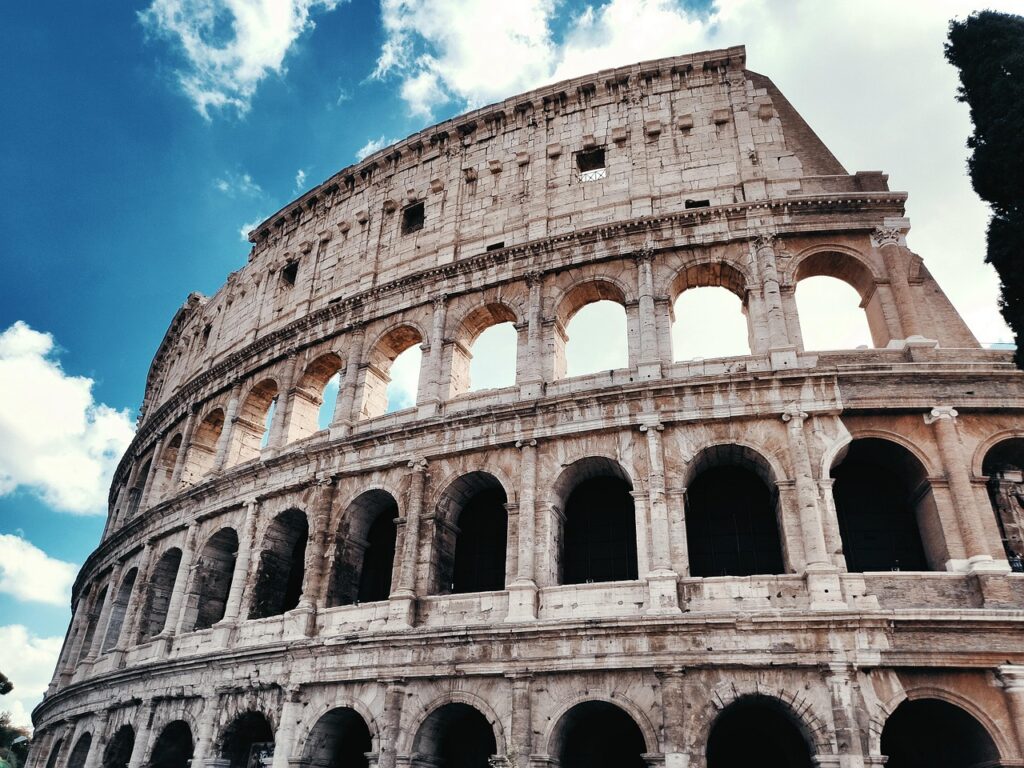
Some places in Rome are unmissable at any age because their history is immediately captivating. One of the best examples is the Colosseum, one of the largest amphitheatres of the ancient world, capable of accommodating tens of thousands of spectators and designed with engineering systems that were advanced for their time. Visiting this iconic Roman landmark is certainly an impressive experience, but it also provides an opportunity to explain to teenagers how ancient spectacles worked, turning the visit into a fascinating story.
Another must-see attraction in Rome is the Roman Forum, which is not an enclosed museum but an open urban space. It was the political, religious and commercial centre of ancient Rome, where trials, assemblies and public celebrations took place. Walking among the ruins allows visitors to visualise how the ancient city functioned, making concepts such as the Republic, the Senate and imperial propaganda easier to understand. It also offers a way to bring history to life for teenagers through direct experience.
The Pantheon is another landmark that easily captures teenagers’ attention. Its enormous central oculus, which allows both sunlight and rain to enter, remains a masterpiece of Roman engineering, while its dome is one of the best-preserved from antiquity. Explaining that this structure is almost two thousand years old and still stands without metal reinforcement often inspires a sense of wonder, even among younger visitors.
The Vatican Museums are another important stop. Established in the 16th century as a collection of ancient sculptures, they have gradually developed into one of the largest and most visited museum complexes in the world, with collections ranging from classical to Renaissance art. The visit culminates in the Sistine Chapel, where Michelangelo’s frescoes provide a visually powerful way to explore themes such as religion, art and history.
Museums and experiences in Rome for young people
When visiting Rome with teenagers, it is worth combining traditional landmarks with more dynamic experiences to keep them engaged, especially as learning becomes easier when there is an element of interaction with what they see.
One effective approach is to choose exhibitions and museums that combine cultural content with interactive features, such as immersive experiences, three-dimensional models and digital displays that encourage direct engagement.
One experience particularly suitable for teenagers is the Leonardo da Vinci Exhibition at Palazzo della Cancelleria, which offers a practical example of how scientific knowledge can be brought to life through historical heritage. Covering approximately one thousand square metres, the exhibition features working machines built from the original drawings found in Leonardo’s codices.
The exhibition includes three-dimensional models, digital reconstructions and multimedia displays explaining Leonardo’s studies of flight, mechanics, hydraulics and anatomy. Its educational value lies in the opportunity to see how a drawing becomes an invention, revealing Leonardo’s creative process and helping teenagers understand how a scientific idea develops, rather than simply learning about the final result.
Underground Rome and hidden places: adventure and discovery
Teenagers are often fascinated by unusual places, and Rome has an extraordinary underground heritage. Beneath the modern city lie ancient streets, Roman buildings, waterways and archaeological spaces that reveal the different stages of its urban history. These layers are the result of centuries of construction and reconstruction, during which existing buildings were often reused as foundations for new ones rather than demolished.
Exploring underground spaces allows teenagers to experience the city as a living organism that changes over time. Catacombs, churches built over earlier structures and underground archaeological remains are undoubtedly fascinating places, but they also offer genuine lessons in urban and social history, where the past is not simply described but literally visible.
One particularly fascinating feature of the Leonardo da Vinci Exhibition is the opportunity to explore the archaeological underground chambers of the palace, where visitors can see a section of the ancient Roman waterway known as the Euripus and the Tomb of Aulus Hirtius, a Roman consul who died in 43 BC. The presence of water and ancient structures creates an immersive setting that brings together archaeology, engineering and history, offering an experience that is difficult to find anywhere else.

How to plan a Rome itinerary with teenagers
When travelling with teenagers, it is best to plan each day with enough time for breaks, relaxed journeys between attractions and moments of independence. Teenagers also appreciate being involved in decisions, so it can be helpful to ask them which places they would like to visit or which subjects interest them most.
Alongside historic landmarks, museums and exhibitions, teenagers may enjoy exploring neighbourhoods such as Ostiense, Pigneto and Tor Marancia, which feature street art trails recognised internationally and studied in academic settings as examples of urban regeneration through public art. These artworks often explore social, environmental and political issues through an immediate visual language that speaks directly to younger generations.
Teenagers who love nature might enjoy visiting Bioparco, a modern zoological park focused on species conservation and environmental education, or the Botanical Garden of Rome, which is home to thousands of plant species from different continents and serves as a natural laboratory for observing biodiversity, plant adaptations and ecological relationships.
A Rome itinerary with teenagers should therefore combine historic landmarks, interactive experiences and outdoor spaces to keep their curiosity alive and prevent tiredness. With its wide range of cultural attractions and green spaces, Rome is particularly well suited to this approach.
A Unique Idea for Your Visit
For a different kind of experience in Rome, explore the interactive Leonardo da Vinci Exhibition
This article was originally published in Italian on 4 February 2026
You can read the Italian version of this article here >