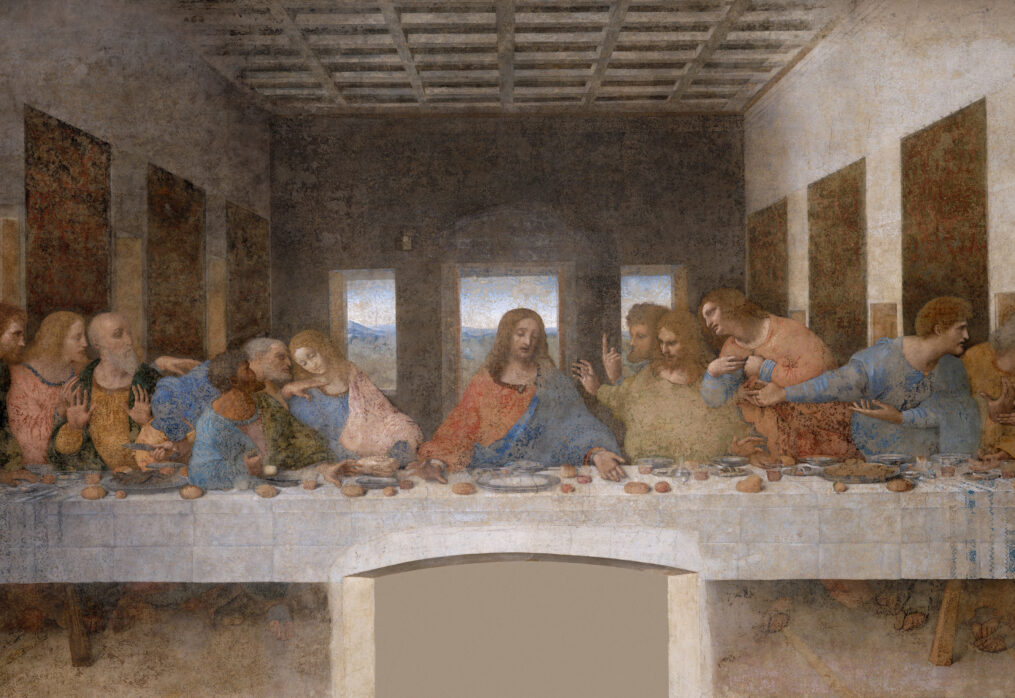

What does Leonardo’s Last Supper really represent, and why is it considered revolutionary? The Cenacolo does not simply depict one of the most famous episodes in the life of Christ, but transforms the announcement of the betrayal into a scene dominated by gestures, glances and emotions.
Painted by Leonardo da Vinci between 1495 and 1498 in the refectory of the convent of Santa Maria delle Grazie in Milan, the Last Supper is one of the most famous works of art in the world. Leonardo chose to depict the moment immediately after Christ announces that one of the apostles will betray him, building a complex sequence of reactions around these words. The twelve apostles question one another, become frightened and indignant, and seek explanations, while Christ remains still at the centre of the composition. But the Cenacolo is also extraordinary for its perspective, the study of the so-called “motions of the mind” and the experimental technique chosen by Leonardo, which gave him great freedom while working but made the painting extremely fragile. Let us discover the figures, meaning and characteristics of this Renaissance masterpiece.
TABLE OF CONTENTS
- Leonardo da Vinci’s Last Supper: figures and meaning
- Composition, perspective and experimentation
- Gestures, emotions and motions of the mind
- Why is the Last Supper so fragile and why is it not a true fresco?
- Where to see Leonardo da Vinci’s Last Supper
Leonardo da Vinci’s Last Supper: figures and meaning
Leonardo da Vinci’s Last Supper depicts Jesus seated at a table with the twelve apostles at the moment when Christ announces that one of those present will betray him. The news spreads across the table, provoking different reactions and emotions among the apostles and filling the scene with tension.
At the centre of the work, we see Jesus Christ, isolated from the movement surrounding him and visually enclosed within a triangular shape. On either side, Leonardo arranges the twelve apostles into four groups of three, each characterised by a different interplay of gestures, glances and reactions that also makes it possible to identify them.
Bartholomew, at the far left, leans forward with his hands resting on the table; next to him is James the Less, with light-coloured hair, and Andrew, who raises both hands as if to reject any suspicion.
In the next group, Peter holds a knife in his right hand and leans towards John, to Christ’s right, depicted according to traditional iconography as a young, beardless man with delicate features. These very features have given rise in modern times to the popular interpretation that the figure is Mary Magdalene, although this hypothesis is not supported by the historical and art-historical interpretation of the work.
Beside them is Judas Iscariot, who draws his body back and clutches the bag containing the money he received for his betrayal. Here Leonardo makes a significant choice: rather than placing Judas alone on the opposite side of the table, as in some other representations of the Last Supper, he keeps him within the group.
On the other side, Thomas raises his characteristic index finger, James the Greater spreads his arms wide and Philip brings his hands to his chest as he turns towards Christ. They are followed by Matthew, who stretches his arms towards Jesus while turning towards his companions, Jude Thaddeus, who appears to question himself while pointing to himself, and finally the elderly Simon, seated at the far right with a more composed attitude.
Inside Leonardo’s World
Experience interactive machines and inventions at the Leonardo Da Vinci Exhibition in Rome
Composition, perspective and experimentation
Leonardo painted the Last Supper on the wall of the refectory, depicting a room that appears to be a continuation of the real space in which the Dominican friars ate. The perspective lines lead towards the centre, and the vanishing point is located at Christ’s head; the ceiling, side walls and tapestries guide the eye into the depth of the scene, while the painted windows in the background ideally open the room onto the landscape. Leonardo also ensured that the light depicted in the work interacted with the natural light entering the room through the windows of the refectory.
In creating this masterpiece, Leonardo adapted the rules of geometry to the actual viewing conditions of the work, tilting the plane of the table so that its surface could be seen and allowing viewers to read the scene clearly even from a certain distance. In the background, the mountains take on cooler, bluish tones according to the principle of aerial perspective that Leonardo would also apply in other works.
As well as experimenting with perspective, in the Last Supper Leonardo also used particular techniques to achieve nuances, lighting effects and details that would have been difficult to obtain while working at the speed required by traditional fresco painting, and this greatly influenced both the final result and the preservation of the work.

Gestures, emotions and motions of the mind
The announcement of the betrayal generates a kind of emotional wave that begins at the centre of the scene and spreads through the different groups: some lean towards Christ, some raise their hands, some turn towards the person beside them, some express sorrow, while others seem to ask in disbelief whether they themselves might be under suspicion.
Leonardo had long studied the relationship between emotion, facial expression and bodily movement, and in the Cenacolo he makes visible what is happening within the mind, transforming anger, fear, astonishment and sorrow into narrative devices that need no explanation because they are conveyed through the position of the hands, the inclination of the bodies, the glances and facial expressions.
The scene is dynamic without being chaotic because, as we have seen, the twelve apostles are arranged in groups of three, creating a rhythm that continually draws the eye towards Christ, who remains relatively isolated and still at the centre, displaying a solemn calm.
Why is the Last Supper so fragile and why is it not a true fresco?
In fresco painting, pigments are applied to plaster while it is still wet and become incorporated into the surface as it dries. The painter must therefore work quickly and complete each section before the plaster dries, with very limited opportunities to make changes afterwards. This method was poorly suited to Leonardo’s slow and meticulous way of working, which is why the Last Supper was not created using the traditional buon fresco technique.
Leonardo instead decided to paint on dry plaster, applying the pigments over a white preparatory layer laid on the dry wall. He used a fatty tempera, with pigments mixed with egg yolk, adopting a method on the wall that was closer to panel painting than to fresco. The aim was to allow him to work slowly, build up layers, correct what he had already painted and devote greater attention to lighting effects and subtle gradations of colour.
However, the freedom gained through this experimentation came at a very high price because, unlike pigments applied to wet plaster, those used for the Cenacolo were not absorbed into the wall but remained on its surface. The painting was therefore extremely vulnerable and began to lose colour within years of its completion. In addition to the characteristics of the technique itself, unfavourable environmental conditions and numerous restoration interventions over the centuries further altered the work.
The last major restoration, directed by Pinin Brambilla Barcilon, lasted more than twenty years and was completed in 1999, following a complex process that also involved removing materials and overpainting from previous interventions. Preserving the Last Supper remains a challenge today: the very technique that allowed Leonardo to achieve exceptional pictorial freedom is also one of the reasons why one of the most famous masterpieces of the Renaissance has survived in such a delicate condition.

Where to see Leonardo da Vinci’s Last Supper
Leonardo da Vinci’s Last Supper is in Milan, on the wall of the refectory of the former Dominican convent of Santa Maria delle Grazie, now part of the Museo del Cenacolo Vinciano. The entrance is at Piazza Santa Maria delle Grazie 2, a short distance from the centre of Milan and also within walking distance of Milano Cadorna station.
The Cenacolo is still in the place for which Leonardo created it at the end of the 15th century, so visiting it allows you to see the work in its original architectural context and better understand the relationship between the real space of the refectory and the space created through perspective in the painting.
Leonardo Live
Visit the Leonardo Da Vinci Exhibition in Rome and discover his machines, inventions, and much more first-hand.
You can read the Italian version of this article here >